


If your next warehouse project is in Chile, Colombia, Peru, British Columbia, or anywhere along the Pacific coast, a standard pallet rack spec is not going to work. Local building authorities in seismic zones will not approve it. Your structural engineer will flag it before you get to the permit stage.
Most buyers discover this late. The project is already scoped, the budget is set, and now there is a redesign on the table. That delay and that extra cost are avoidable.
HEDA SHELVES has built seismic-rated pallet racking for warehouses in high-risk earthquake zones across South America and beyond. This article covers what seismic rack design actually involves, which regions require it, and how we handle the four problems that come up on almost every project.
What "Seismic-Rated" Actually Means for a Pallet Rack
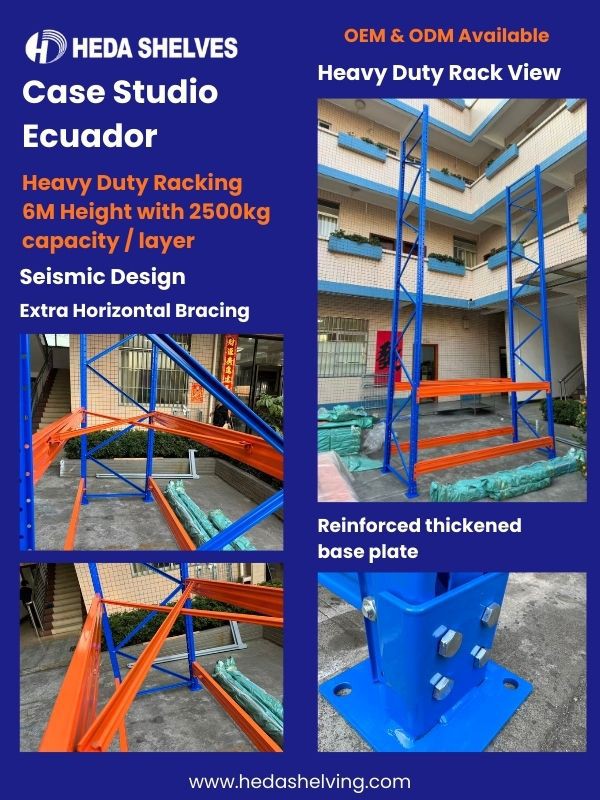
Seismic design is not a sticker on a standard rack. It means specific structural changes to the frame, the base plate, and the bracing at every bay level. At HEDA SHELVES, three structural upgrades are standard on every seismic project.
Reinforced Rack Frame
We use heavier upright profiles with increased steel gauge. The column cross-section is sized to handle vertical load plus the lateral forces that come from ground movement. Standard frames are not designed for this combination. For high-risk zones (Seismic Design Category D, E, or F), this upgrade is not negotiable.
Oversized Footer Plates
Standard base plates are too small for seismic zones. We use enlarged, thickened footers with deeper anchor bolts and greater bearing area against the concrete slab. This is what keeps the rack in position during sustained ground motion. Our footers are sized per project based on the site's seismic design category, not pulled from a standard catalogue.
X-Bracing at Every Bay Level
Each bay gets X-bracing on the sides and across the top. X-braces work in tension rather than compression, which means they stay effective through repeated movement cycles. Lateral forces move through the brace rather than building up at the column base. For high-risk seismic zones, this approach outperforms standard diagonal bracing configurations.
Which Warehouses Actually Need Seismic Racking
More than most buyers expect. Regions with active seismic requirements include:
- South America's Pacific coast: Chile, Peru, Colombia, Ecuador, and parts of Argentina
- Canada: British Columbia and parts of Quebec and Ontario near fault lines
- Western USA: California, Oregon, Washington, Nevada, Utah
- Pacific Rim: Japan, Taiwan, Indonesia, New Zealand, the Philippines
- Parts of the US Midwest: The New Madrid Seismic Zone covering Missouri, Arkansas, Tennessee, and surrounding states
If you are sourcing a seismic racking solution for any of these locations, your project has specific engineering requirements that standard pallet rack cannot meet. Local authorities having jurisdiction (AHJ) will not issue permits for rack installations that lack seismic calculations and compliant structural drawings. Your site address and soil classification determine the actual design category, and that category drives every structural decision in the rack design.
Four Chenllges of Every Seismic Rack Project
These are not edge cases. They come up on nearly every project where a buyer is sourcing seismic-rated racking from overseas for the first time.
Problem 1: The Rack Does Not Meet Local Structural Code
South American and Canadian building departments have specific requirements for rack structures in seismic zones. These cover minimum upright gauge, base plate size, anchor bolt specifications, and bracing configuration per bay. Many overseas rack suppliers ship a standard design and expect someone else to handle structural compliance.
How HEDA SHELVES responds: We build the seismic requirements into the product from the start. Reinforced frames, properly sized footers, and X-bracing are part of our seismic design package, not add-ons we offer at extra cost. We have shipped seismic-rated pallet racking to projects in Chile, Colombia, and Canada, and we understand what structural engineers and local permit offices look for. When our drawings go to a local engineer for review, they are already built to the right structural standard.
Problem 2: No Design Support and Logistics Costs Running Over Budget
Sourcing rack overseas and then paying a third-party engineer for compliant drawings is expensive and slow. Every revision adds cost. If components are wrong and air freight is needed for replacements, the budget goes sideways fast.
How HEDA SHELVES responds: Free warehouse layout design is included with every project inquiry. Our engineering team handles the drawings, load calculations, and bay configuration. We prepare the full documentation package for permit submission. We also coordinate with installation engineers in your region so you have on-the-ground support during commissioning. You see one project cost in the quote, and that is close to what you actually pay at the end.
Problem 3: High Labor Costs and Not Enough Storage Density
The racking system type has a direct effect on how many people you need to run the warehouse. HEDA SHELVES offers three storage systems specifically designed to reduce labor and increase capacity. All three can be built with seismic-rated structural components.
Drive-in racking: Forklifts enter the rack lane directly. No pick aisles are needed between rows. Storage density increases significantly compared to selective racking. Best for bulk storage with fewer SKUs, cold stores, or any warehouse where density matters more than direct access to individual pallets.
Gravity flow racking: Pallets are loaded from the rear and roll forward on inclined roller lanes to the pick face. Loading and picking happen on opposite ends of the bay with no operator travel needed between them. Works well for high-turnover FIFO operations where replenishment speed matters.
Radio shuttle racking: A battery-powered shuttle vehicle runs inside the rack lane and positions pallets automatically. Forklift travel time drops sharply. Deep storage lanes can be used without forklifts entering the rack, which improves both density and equipment safety. Good fit for large distribution warehouses with repetitive pallet movement patterns.
Problem 4: Inconsistent Quality from Previous Suppliers
Buyers who have worked with low-cost suppliers before know what this looks like. Surface rust in the first year. Warped components that slow installation. Welds that fail under repeated load cycles. These problems are not visible when you inspect a sample. They show up months after the warehouse is running.
How HEDA SHELVES responds: We control the full production process in-house. The coating process starts with acid-washing, which removes mill scale and surface contamination from the steel before any powder coat is applied. This step is what determines long-term rust resistance. Without it, rust starts at the steel surface even when the powder coat looks intact from the outside.
After pre-treatment, components go through automatic powder coating for a uniform surface finish. Welding uses automatic equipment for consistent weld quality across every component. Each piece is dimensionally inspected before it goes into a shipment.
Our racks carry CE-CPR certification (the European standard for structural steel construction products), which requires independent verification of design methodology, materials, and production process. It is one of the clearest third-party quality signals available when comparing rack suppliers from different countries.
How HEDA SHELVES Service For Your Seismic Racking Project
Custom Design
Your warehouse is not a catalogue item. Pallet size, load weight, bay depth, aisle width, and seismic design category all affect the final rack specification. HEDA SHELVES produces a custom layout for every project. We start from your floor plan and site conditions, not a standard template.
Custom seismic pallet rack design from HEDA SHELVES includes structural calculations, drawing packages for permit submission, and component specifications matched to your site's seismic design category. If your project requires PE-stamped drawings through a local structural engineer, we prepare the full documentation package to support that review. Nothing gets left for you to figure out later.
Full-Service Support
You should not need five separate vendors to get a warehouse project to completion. HEDA SHELVES handles design, manufacturing, shipping coordination, and on-site installation support as a single package.
Free layout design is included with every project inquiry. Our team produces the drawings and checks the design against your seismic requirements before we quote. We maintain relationships with installation engineers in South America, Canada, and other key markets, so you have support on the ground when the rack arrives and goes up. If something needs to be adjusted during installation, we have people who can respond, not just a phone number at a head office.
Experience in Seismic Projects
HEDA SHELVES has shipped seismic-rated pallet racking to warehouses in high-risk earthquake zones across South America and the Pacific Rim. We are familiar with the structural requirements that come with these projects, including what each seismic design category demands from the frame, the footer, and the bracing configuration.
We also supply standard pallet racking for non-seismic projects. That means our production team is not encountering seismic design for the first time when your project comes in. It is a variant we produce on a regular basis, with documented project history and real-world inspection results to back it up.
Verified Quality
CE-CPR certification covers the full production chain, not just the finished product. It means our design process, material sourcing, welding, and quality control have been independently assessed and confirmed.
On the factory floor: acid-washing pre-treatment, automatic welding, electrostatic powder coating, and dimensional inspection per component. Surface finish is smooth and consistent, which matters for corrosion resistance in humid warehouse environments. Steel grade used in our seismic frames meets the requirements for structural load-bearing applications.
A rack that looks fine in product photos but uses inferior pre-treatment and manual welding will not perform the same way over a ten-year service life. The difference shows up in the field, not in the catalogue.
How to Choose a Seismic Rack Supplier
Five checks that will save you problems later.
- 1. Confirm your Seismic Design Category before getting quotes. Your structural engineer or local building department can give you the SDC for your site, from A (low) to F (high). This determines what the frame, base plate, and bracing need to be. Do not let a supplier quote without knowing this first.
- 2. Do not compare price by steel weight alone. Seismic performance comes from design configuration, not just material quantity. A cheaper rack with thin footers and no X-bracing will not pass inspection. You will pay more to fix it than you saved buying it.
- 3. Ask specifically about the pre-treatment process. Acid-washing before powder coat is not something every factory does. If a supplier cannot confirm this step, the rack rust timeline shortens considerably, especially in coastal or humid environments. Ask for documentation or factory process records.
- 4. Request documented experience in seismic regions. Any manufacturer can claim they build seismic rack. Ask for actual project references, inspection records, or permit approvals from earthquake-prone locations. Experience in these markets means the supplier understands local inspection requirements in practice.
- 5. Check whether installation support is included. Overseas suppliers that drop the rack at the port and disappear create problems. Confirm that your supplier provides installation guidance, on-site support coordination, and a process for handling field adjustments during commissioning.
Ready to Start Your Seismic Rack Project?
If your warehouse is in a seismic zone, the decisions you make at the quoting stage determine whether you pass inspection, stay on budget, and end up with a rack that holds up.
HEDA SHELVES offers a complete seismic racking solution built around your site: custom design from your floor plan, CE-CPR certified production, free layout drawings included, and installation support in your region.
Send us your warehouse dimensions, pallet load data, and site location. Our team will come back with a layout and project quote within a few business days.
Contact HEDA SHELVES for a Free Seismic Rack Design and Quote