


Warehouse layout design directly dictates operational throughput and facility safety. A single miscalculation in pallet rack spacing can compromise forklift maneuverability, violate local fire codes, or underutilize vertical cube space.
Achieving maximum storage density without sacrificing selective speed requires strict adherence to documented engineering clearances and logistical standards. This guide details exact spacing requirements across distinct racking systems, materials, and industrial sectors.
Pallet Rack Spacing Standards & Requirements
Pallet rack spacing is governed by strict compliance frameworks to prevent structural collapse and ensure fire suppression efficacy.
In the United States, rack design and safety parameters must comply with the Rack Manufacturers Institute (RMI) ANSI MH16.1 specification and OSHA 1910.176(a) regarding secure material storage.
For fire safety, NFPA 13 (Standard for the Installation of Sprinkler Systems) dictates precise flue spaces to allow vertical heat venting and sprinkler water penetration during an incident.
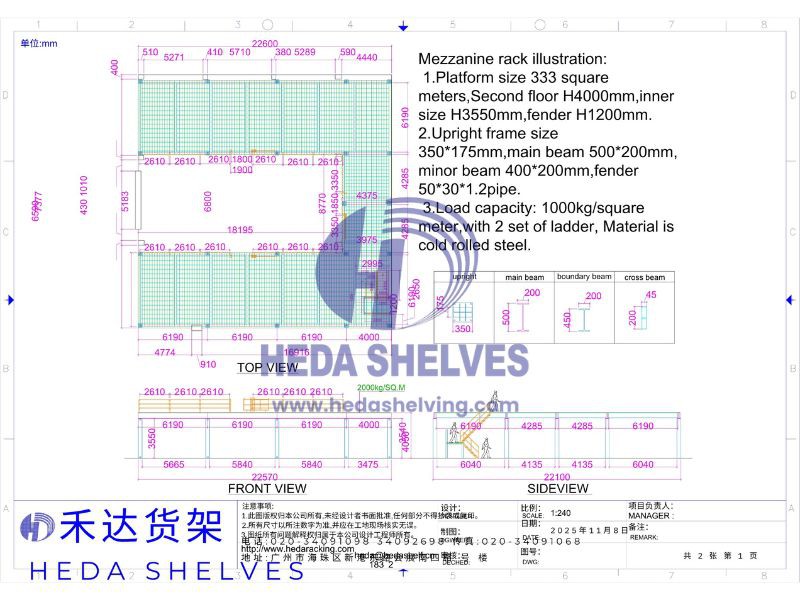
Which Racking Spacing You Should Consider
Designing a functional warehouse racking system requires isolating five distinct spatial dimensions.
Clearance Spacing
Clearance spacing defines the internal horizontal buffer within a single bay. The standard industry metric requires a minimum of 3 inches of clearance between the outer edge of the pallet load and the upright frame. Additionally, a minimum of 4 inches of clearance must be maintained between the two adjacent pallet loads positioned on the same beam level to eliminate mid-bay impact during placement.
Flue Spacing
Flue spacing refers to the clear vertical openings within the rack structure.
- Transverse Flue Space: The gap between the commodity loads along the aisle.
- Longitudinal Flue Space: The perpendicular space between back-to-back rack rows. NFPA 13 explicitly mandates a continuous minimum longitudinal flue space of 6 inches for any rack storage exceeding 25 feet in height to maintain an unobstructed fire pathway.
Aisle Spacing
Aisle spacing is the clear distance between opposing rack faces across an aisleway. This dimension is entirely dependent on the specific material handling equipment deployed, creating three primary classifications:
- Wide Aisles: 12 to 14 feet.
- Narrow Aisles (NA): 8.5 to 10 feet.
- Very Narrow Aisles (VNA): 5.5 to 7 feet.
Vertical Clearance
Vertical clearance is the space between the top of the palletized load and the bottom of the beam immediately above it. Standard operational protocols mandate a minimum of 6 inches of vertical clearance. This buffer accounts for the lift-and-tilt arc required by forklift operators to cleanly disengage a pallet from the beam without clipping the upper structural components.
Wall Clearance
Wall clearance represents the buffer zone between the perimeter walls of the facility and the outermost rack rows. NFPA codes and building regulations frequently require a minimum of 6 to 12 inches of rear clearance from building columns and walls to prevent structural damage to the facility during loading and to accommodate utility runs or perimeter egress pathways.
Factors of Pallet Rack Spacing
- Material Handling Equipment (MHE): The minimum turning radius, chassis length, and right-angle stack dimensions of the forklift fleet determine the baseline for aisle width.
- Pallet Overhang: Standard Heda Shelves heavy-duty pallet rack systems typically feature a frame depth of 42 inches to support standard 48-inch long pallets. This design intentionality results in a 3-inch pallet overhang at both the front and rear faces of the rack, which must be factored directly into flue space and aisle calculations.
- Commodity Classification: Products classified under NFPA as Class I-IV commodities require standard flue spacing, whereas high-hazard Group A plastics trigger enhanced vertical and longitudinal clearance mandates to accommodate in-rack sprinkler lines.
How to Layout Right Racking Spacing
Spatial Configurations Across Racking Systems
Different storage configurations completely alter spacing baselines due to their operational mechanics:
- Selective Pallet Racking System: This standard configuration utilizes standard 6-inch flue spacing via row spacers between back-to-back structures, maintaining 100% selectivity with standard wide or narrow aisle dimensions.
- Drive-In / Drive-Through Systems: These high-density systems eliminate standard aisles. Internal bay clearances are constricted; the internal clearance between the inner edges of the drive-in rails must precisely match the width of the forklift chassis plus a rigid safety buffer of 2 to 3 inches on either side.
- Push-Back & Pallet Flow Racking: These dynamic systems utilize inclined rails or roller beds. The vertical clearance between levels must be increased to 8 to 10 inches to compensate for the slope angle of the lanes and the pitch changes as pallets advance forward.
Fast Quote With Pallet Position Number
Industry-Specific Spacing Requirements
- Cold Storage & Food Logistics: Operating costs per cubic foot are highly elevated in freezer environments. Spacing layouts shift toward VNA or mobile racking systems to compress aisles to a minimum. However, vertical clearance must often be extended near freezer blowers to prevent ice formation and ensure proper cold airflow distribution.
- Automotive & Heavy Manufacturing: Handling heavy steel bins or custom oversized skids requires expanding standard 3-inch clearance spacing to 4 or 6 inches per side to account for irregular container shifting and high-capacity loading variations.
- Pharmaceutical Warehousing: Compliance with FDA and GWP (Good Warehousing Practices) requires explicit wall clearances up to 18 inches to permit routine sanitization, pest control monitoring, and thorough ambient air circulation around all stored inventory.
Forklift Type & Aisle Width (Aisle Width)
Selecting the appropriate aisle layout requires alignment with the operational specifications of your material handling fleet. The table below outlines the minimum clear aisle widths based on forklift class:
| Forklift Type | Operational Characteristics | Minimum Aisle Width | Typical Application |
| Standard Counterbalance Forklift | Employs rear-wheel steering; requires a wider turning radius for load positioning. | 12 - 14 Feet | High-throughput, multi-purpose industrial facilities. |
| Reach Truck | Outriggers support the load weight; pantograph mechanism extends forks forward into the rack. | 8.5 - 10 Feet | High-density warehouse setups leveraging standard high-bay systems. |
| VNA Turret Truck | Operates on wire-guided or rail-guided paths; the mast rotates 180 degrees to service both sides without turning the chassis. | 5.5 - 7 Feet | Specialized logistics hubs requiring maximum volumetric optimization. |
Case Studies
Industrial Manufacturing Hub (Ecuador)
- Type: Selective Pallet Racking
- Forklift: Standard Forklift
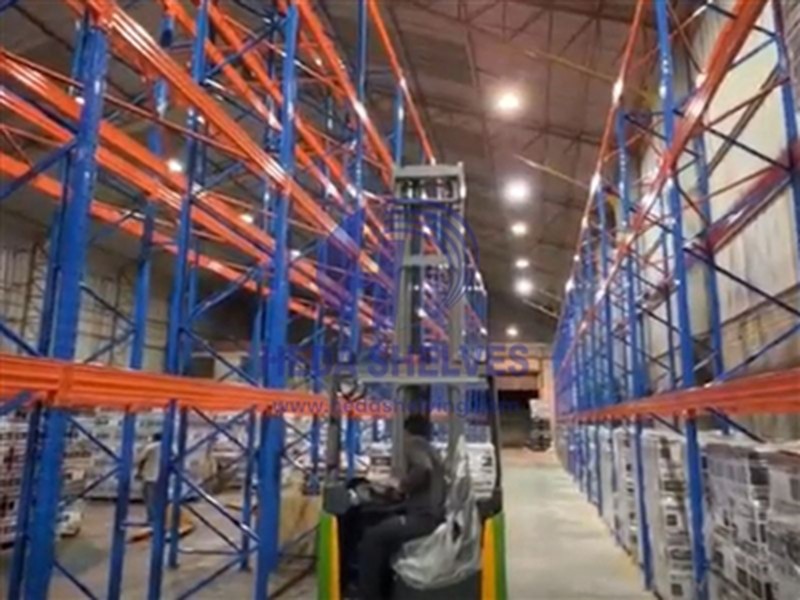
Multi-Tier Material Mezzanine (Malaysia)
- Type: Selective Pallet Racking
- Forklift: Standard Forklift

Multi-Tier Material Storage Racking (Netherland)
Type: Drive-in Racking & Cantilever Rack
Forklift: Standard Forklift

Expert Tips for Layout Optimization
- Commit to MHE Dimensions Prior to Rack Procurement: Never design a layout based on generalized asset estimates. Obtain the exact technical spec sheet of your chosen forklift model and verify the manufacturer-certified Right Angle Stack dimension before calculating aisle footprints.
- Account for Overhang in Row Spacer Calculations: If your pallets feature a 3-inch rear overhang, utilizing standard 6-inch row spacers in a back-to-back configuration reduces your net longitudinal flue space to 0 inches. To retain a legal 6-inch fire flue under NFPA standards, you must deploy 12-inch row spacers.
- Install Structural Column Protectors: Tight aisle designs increase the statistical frequency of frame impacts. Outfitting the base of vulnerable uprights with bolt-down or anchor-free steel column protectors preserves structural integrity without shrinking usable clearance lanes.
Conclusion
The ideal pallet rack spacing layout represents a precise engineering balance between regulatory fire safety compliance, material handling efficiency, and maximum volumetric utilization. Securing this configuration prevents costly structural failures and eliminates operational friction.
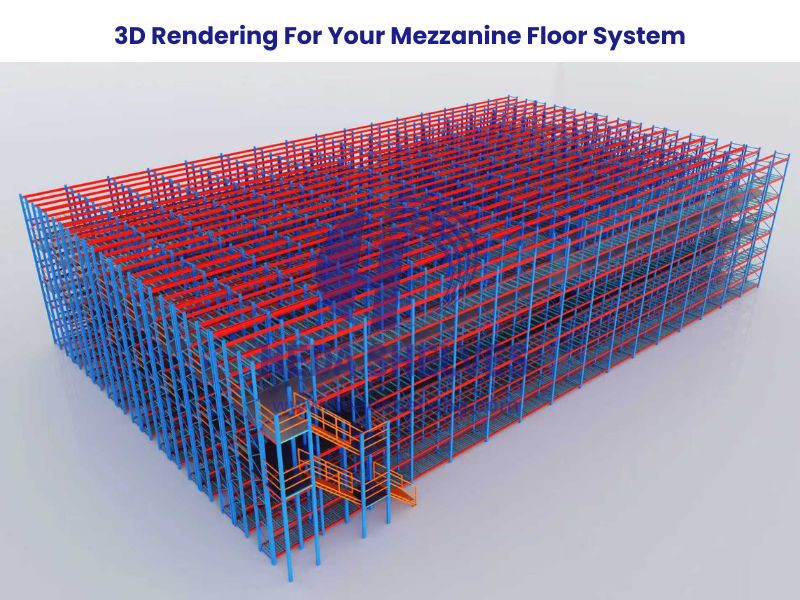
Are you currently planning a new warehouse layout or seeking to optimize the spatial efficiency of an existing facility?
Contact the industrial engineering team at Heda Shelves today to receive a tailored, code-compliant pallet racking system CAD/3D rendering for free.