


Quick Answer
There is no single steel gauge suitable for every supermarket shelf component. As a reference, HEDA SHELVES published gondola shelving configurations use 0.6–0.7 mm shelf panels, 1.2–2.0 mm upright profiles, 2.0–2.2 mm shelf brackets and 0.5–0.6 mm back panels. The appropriate specification depends on shelf dimensions, structural design, reinforcement and required load capacity. When comparing suppliers, request thickness in millimeters alongside the component drawing and rated load.
Key Takeaways
- Different components need different thicknesses. Uprights, shelf panels, brackets and back panels perform different structural functions.
- Millimeters are more precise than gauge numbers. Gauge conversion depends on the applicable steel gauge standard.
- Thickness alone does not determine load capacity. Shelf geometry, folded edges, reinforcement and bracket design also affect performance.
- HEDA SHELVES uses multiple specification series. Published gondola configurations range from 1.2 mm to 2.0 mm upright profiles and 0.6 mm to 0.7 mm shelf panels.
- Check the complete specification. Compare steel grade, base material thickness, dimensions, reinforcement and rated loading conditions.
1. What Steel Thickness Is Used for Supermarket Shelves?
Supermarket gondola shelving is generally manufactured from cold-rolled steel, with different thicknesses selected for different components.
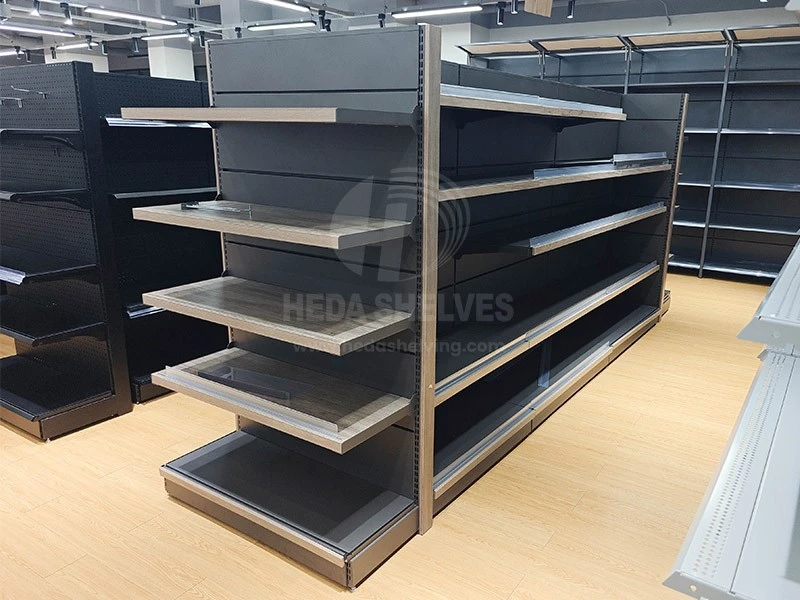
A complete gondola unit contains several steel parts:
- Upright columns supporting the shelving structure.
- Shelf panels holding merchandise.
- Shelf brackets transferring shelf loads to the uprights.
- Base shelves supporting heavier merchandise near floor level.
- Back panels providing the rear display surface.
- Base legs and connecting components supporting the overall structure.
- These components do not need identical thicknesses.
For example, a shelf panel may use thinner formed steel because its edges and supporting brackets contribute to its stiffness. An upright profile needs a different specification because it carries loads from multiple shelf levels.
1.1 Typical Steel Thickness by Component
The following table shows the thickness ranges found in commercial gondola shelving configurations. These are reference ranges, not universal minimum requirements.
| Component | Reference thickness | Main function |
|---|---|---|
| Shelf panel | 0.6–0.8 mm | Supports displayed merchandise |
| Upright profile | 1.2–2.0 mm | Supports the complete shelving structure |
| Shelf bracket | 2.0–2.2 mm | Transfers shelf loads to uprights |
| Back panel | 0.5–0.6 mm | Provides the rear display surface |
| Base leg and support parts | Design-dependent | Supports and stabilizes the structure |
Actual specifications depend on the selected gondola series, component geometry and intended loading conditions.
1.2 HEDA SHELVES Gondola Steel Thickness Specifications
HEDA SHELVES offers different gondola shelving configurations for retail applications.
Its published 50, 60, 70 and 80 series specifications provide a useful example of how component thickness changes across different shelving configurations.
| Component | 50 Series | 60 Series | 70 Series | 80 Series |
|---|---|---|---|---|
| Upright profile | 30 × 50 × 1.2 mm | 30 × 60 × 1.5 mm | 30 × 70 × 1.8 mm | 30 × 80 × 2.0 mm |
| Shelf panel | 0.6 mm | 0.6 mm | 0.7 mm | 0.7 mm |
| Back panel | 0.5 mm | 0.5 mm | 0.6 mm | 0.6 mm |
| Shelf bracket | 2.0 mm | 2.0 mm | 2.2 mm | 2.2 mm |
These figures illustrate the differences between components and product series. They should not be interpreted as a universal load-capacity ranking.
For an actual supermarket project, the final thickness and structural specifications should be confirmed against the selected dimensions, shelf configuration and required loading conditions.
2. Steel Gauge vs. Steel Thickness in Millimeters
When purchasing supermarket shelving, suppliers may quote steel thickness using either millimeters or gauge numbers.
For example:
- 0.6 mm steel
- 24 gauge steel
- Both describe sheet metal thickness, but the conversion depends on the gauge standard being used.
- This can create confusion when comparing quotations from manufacturers in different countries.
2.1 What Does Steel Gauge Mean?
Steel gauge is a numerical system used to describe the thickness of sheet metal.
In the commonly referenced US Standard Steel Gauge system, a lower gauge number indicates thicker steel.
For example:
- 14 gauge is thicker than 16 gauge.
- 16 gauge is thicker than 18 gauge.
- 18 gauge is thicker than 20 gauge.
- 20 gauge is thicker than 22 gauge.
This is the opposite of what some buyers initially expect.
Gauge is a traditional reference system. For international manufacturing orders, specifying the actual thickness in millimeters is generally clearer.
2.2 Steel Gauge to Millimeter Conversion Chart
The following chart uses approximate US standard steel sheet gauge equivalents.
| US Steel Gauge | Approximate Thickness (mm) | Common Reference |
|---|---|---|
| 13 Gauge | 2.28 mm | Heavy sheet steel |
| 14 Gauge | 1.90 mm | Structural shelving components |
| 15 Gauge | 1.80 mm | Heavy formed components |
| 16 Gauge | 1.52 mm | Upright and structural components |
| 18 Gauge | 1.21 mm | Light structural sheet components |
| 20 Gauge | 0.91 mm | General sheet metal |
| 22 Gauge | 0.76 mm | Thin sheet metal |
| 23 Gauge | 0.69 mm | Shelf panels |
| 24 Gauge | 0.61 mm | Shelf panels |
| 25 Gauge | 0.56 mm | Thin back panels |
| 26 Gauge | 0.46 mm | Thin sheet metal |
Important: These are approximate US standard steel sheet equivalents. Other gauge systems, including galvanized steel gauge tables, may use different conversion values. Gauge numbers should not be used without identifying the applicable standard.
2.3 Why Millimeters Are Better for International Shelving Orders
For a supermarket shelving project, the supplier and customer may be located in different countries.
One quotation may specify 18 gauge steel, while another uses 1.2 mm steel.
Although these values are approximately equivalent under the US standard steel gauge system, the actual ordering specification should state the nominal thickness in millimeters.
A clear specification should include:
- Component name
- Material grade
- Nominal steel thickness in mm
- Profile dimensions
- Manufacturing drawing
- Thickness tolerance
- Applicable load rating
It is also important to establish whether the stated thickness refers to the base steel before powder coating or the finished coated component.
This makes technical comparisons more reliable and reduces misunderstandings during production.
3. What Steel Thickness Do Different Supermarket Shelf Components Need?
The correct steel thickness depends on what each component needs to support.
A shelf panel supports merchandise directly, while an upright carries loads transferred through several shelf levels. A bracket transfers the shelf load to the upright.
Understanding these structural functions is more useful than comparing thickness numbers without considering the component design.
3.1 Shelf Panel Thickness
The shelf panel is the horizontal surface where merchandise is displayed.
Its thickness affects:
- Panel stiffness
- Resistance to bending
- Surface deformation under distributed loads
- Long-term performance under repeated loading
- Overall shelf construction
For standard metal gondola shelving, 0.6–0.7 mm shelf panels are used in HEDA SHELVES published configurations.
A thicker panel may be appropriate for wider shelves, heavier merchandise or different structural designs.
However, thickness is only one part of the design.
Shelf length, depth, folded front and rear edges, reinforcement bars and bracket spacing also influence the final load capacity.
For example, two shelf panels made from the same 0.7 mm steel may have different performance if one uses reinforced folded edges and the other has a flat, unsupported design.
When selecting shelf panels, check:
- Shelf length and depth
- Steel thickness
- Folded edge dimensions
- Reinforcement structure
- Bracket quantity and spacing
- Rated load per shelf
- Required loading conditions
3.2 Upright Column Thickness
Uprights are the vertical structural components of gondola shelving.
They support the brackets and transfer loads from the shelf levels to the base.
Unlike a flat shelf panel, an upright usually has a formed profile that provides additional structural stiffness.
HEDA SHELVES published gondola configurations include upright profiles ranging from 30 × 50 × 1.2 mm to 30 × 80 × 2.0 mm.
When evaluating upright specifications, consider:
- Profile width and depth
- Steel thickness
- Upright height
- Perforation and connection design
- Base connection
- Shelf loading arrangement
- Stability of the complete shelving unit
A larger upright profile with a suitable wall thickness can provide a different structural performance from a smaller profile made using thicker steel.
The two dimensions should always be evaluated together.
3.3 Shelf Bracket Thickness
Shelf brackets connect the shelf panel to the upright structure.
They transfer merchandise loads from the shelf surface to the vertical columns.
Because brackets are directly involved in this load-transfer path, their thickness and geometry are important.
HEDA SHELVES published series specifications use 2.0–2.2 mm shelf brackets.
Important bracket design factors include:
- Steel thickness
- Bracket length
- Cross-sectional profile
- Hook or connector design
- Engagement depth
- Number of supporting brackets
- Connection strength
A thick shelf panel cannot compensate for an unsuitable bracket.
The bracket and its connection to the upright must be able to transfer the required shelf load.
3.4 Back Panel Thickness
The back panel forms the rear surface of a gondola shelving unit.
Its main functions depend on the selected back panel configuration.
Common options include:
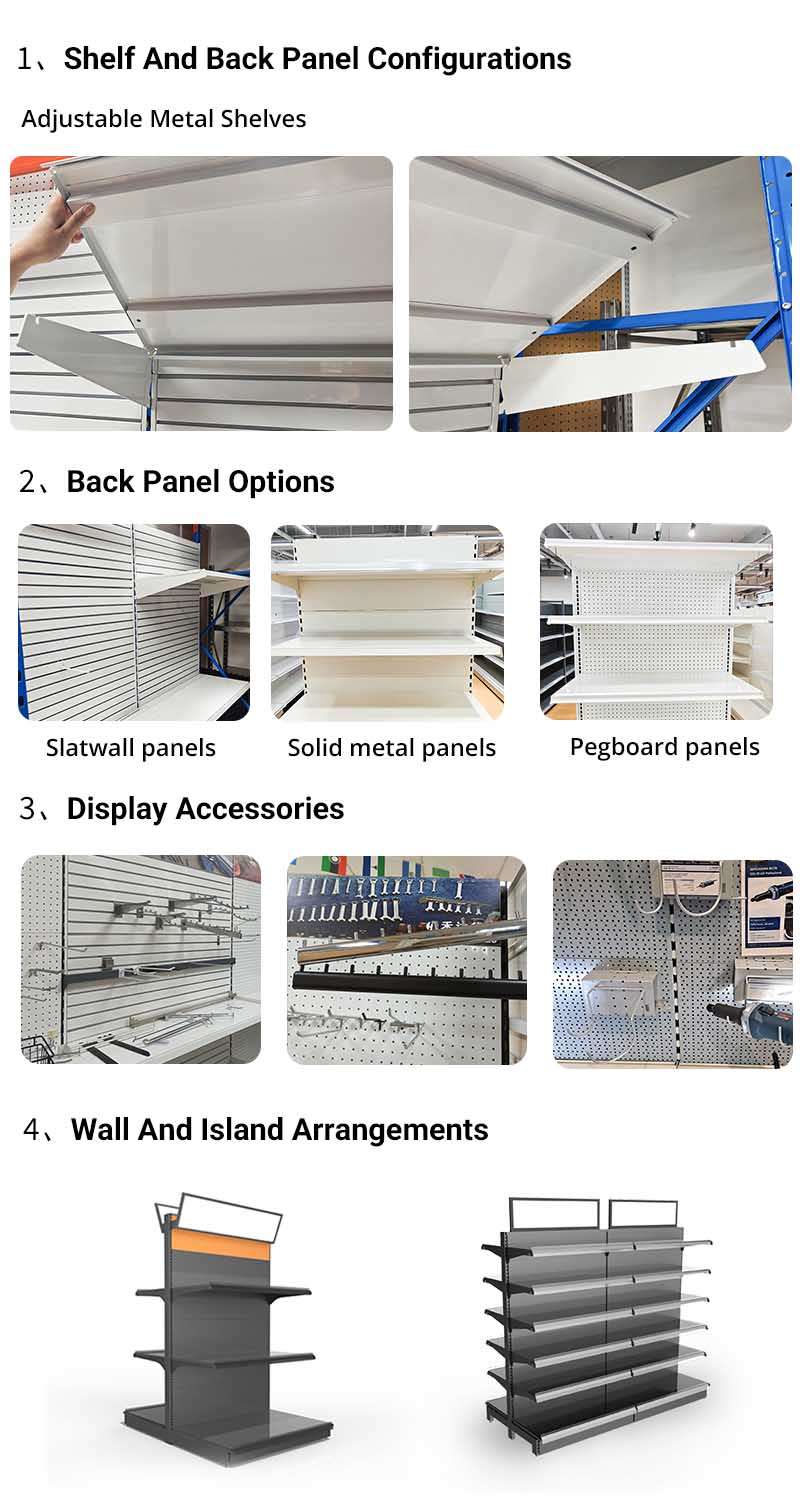
- Solid Back Panel: A flat metal panel creates a continuous rear display surface. It is commonly used for conventional shelf-based merchandising.
- Pegboard Back Panel: A perforated panel provides holes for compatible hooks and display accessories. Its hole arrangement and panel structure need to suit the intended accessory loads.
- Slatwall Back Panel: A slatwall panel uses horizontal slots to accommodate compatible display accessories. Its slot geometry and structural support should match the intended merchandising configuration.
HEDA SHELVES published specifications include 0.5–0.6 mm back panels in certain gondola series.
However, the back panel should not automatically be treated as a load-bearing structural member. Its actual function depends on the design and accessory configuration.
For displays involving heavy hanging products, the panel and its attachment points need to be evaluated for the intended loads.
3.5 Base Shelf and Bottom Support
The bottom shelf is often used for larger or heavier merchandise, including bulk packages and beverage products.
Its design may differ from upper shelf levels.
Consider:
- Panel thickness
- Shelf depth
- Reinforced edges
- Base support structure
- Floor clearance
- Merchandise weight distribution
The base shelf should be specified according to its intended loading conditions, not simply because it is positioned closest to the floor.
4. Does Thicker Steel Always Mean Higher Shelf Load Capacity?
No. Steel thickness contributes to shelf strength and stiffness, but it does not independently determine the rated load capacity.
A supermarket shelf is a structural assembly.
Its performance depends on several interacting factors.
4.1 Shelf Dimensions and Span
The length and depth of a shelf influence how it behaves under loading.
A longer shelf may experience greater bending under the same distributed load if its support arrangement remains unchanged.
A deeper shelf also changes the load distribution and bending behavior.
Therefore, a 1200 mm shelf should not automatically receive the same load rating as a 900 mm shelf simply because both use the same steel thickness.
4.2 Folded Edges and Reinforcement
Metal shelf panels are often formed with folded front and rear edges.
These folds increase section stiffness and help control deformation.
Additional reinforcement bars can also improve shelf performance.
Compare the following configurations:
| Shelf Design | Structural Characteristics |
|---|---|
| Flat sheet | Limited stiffness without additional support |
| Folded-edge shelf | Improved section stiffness |
| Folded-edge shelf with reinforcement | Additional support against deformation |
| Heavy-duty formed shelf | Designed around higher loading requirements |
The actual performance depends on the complete geometry and manufacturing specification.
4.3 Shelf Bracket Design
Brackets transfer loads from the shelf panel to the upright.
A shelf panel may remain relatively flat under loading, but its bracket connections can still become the limiting structural component.
Check:
- Bracket thickness
- Bracket profile
- Connection engagement
- Number of brackets
- Shelf support spacing
The shelf panel and bracket should be evaluated as one supporting assembly.
4.4 Steel Grade and Material Properties
Steel grade also affects structural performance.
For example, HEDA SHELVES uses Q235B cold-rolled steel in relevant gondola shelving configurations.
The material specification should identify the applicable steel grade and its mechanical properties.
Two steel sheets with identical thickness do not necessarily have identical yield strength or mechanical performance.
For this reason, steel thickness and steel grade should be specified separately.
4.5 Load Distribution and Rated Capacity
A shelf load rating should be associated with a defined loading condition.
Important distinctions include:
Uniformly distributed load
Concentrated load
Load positioned near the shelf edge
Load supported by multiple contact points
Total load across the complete shelving unit
A shelf rated for a particular uniformly distributed load should not automatically be assumed to support the same weight concentrated at one point.
The rating should also identify whether it applies to an individual shelf or another part of the shelving structure.
5. Steel Thickness Comparison for Different Retail Applications
Different merchandise categories create different shelf loading requirements.
A supermarket displaying packaged snacks has different requirements from a beverage store or hardware retailer.
The following table provides an application-based comparison.
| Retail Application | Main Shelf Considerations | Specification Focus |
|---|---|---|
| Cosmetics and personal care | Smaller packages and lighter merchandise | Shelf dimensions and display finish |
| Snacks and packaged food | Regular merchandise distribution | Shelf panel stiffness and bracket support |
| General grocery | Mixed product weights and package sizes | Shelf capacity and structural configuration |
| Beverage displays | Concentrated product weight and heavier packages | Reinforced shelves and suitable supports |
| Hardware stores | Dense and sometimes concentrated loads | Shelf construction, brackets and uprights |
| Warehouse-style retail | Combined display and reserve stock requirements | Separate evaluation of retail and storage structures |
For example, beverage products can create higher concentrated loads than lightweight packaged goods.
A shelf specification suitable for snacks should not automatically be applied to beverage displays.
The correct design should follow the actual merchandise weight, package dimensions, shelf size and loading arrangement.
6. How to Check Steel Thickness When Comparing Supermarket Shelving Suppliers
When comparing quotations, a single statement such as heavy-duty steel or thickened material is insufficient.
A technical specification should identify the thickness and design of each major component.
6.1 Request a Component Thickness Schedule
Ask the supplier to provide a component-by-component specification.
| Item | Required Information |
|---|---|
| Upright | Profile dimensions and wall thickness |
| Shelf panel | Length, depth and sheet thickness |
| Shelf bracket | Thickness, profile and connection details |
| Back panel | Panel type and thickness |
| Base shelf | Dimensions, thickness and reinforcement |
| Base support | Material thickness and structural configuration |
This allows different quotations to be compared using the same technical basis.
6.2 Confirm the Steel Thickness in Millimeters
If a supplier provides gauge numbers, request the corresponding millimeter values and the gauge standard.
For example, a quotation specifying 18 gauge steel should also identify the nominal thickness in millimeters.
Do not assume that every manufacturer's gauge reference uses the same conversion table.
6.3 Check the Actual Steel Thickness
A digital caliper or micrometer can be used to check accessible steel components.
For a meaningful inspection:
Identify the component being measured.
Check an accessible flat section rather than a folded edge.
Account for surface coating if measuring the finished component.
Compare the measurement with the agreed nominal base-metal thickness and tolerance.
Record the results for different components.
A single measurement should not be used to represent the entire shelving system.
6.4 Check the Drawings and Load Specifications
Thickness should be reviewed together with the product drawing and load rating.
Confirm:
- Overall shelving dimensions
- Upright profile dimensions
- Shelf panel construction
- Bracket configuration
- Reinforcement details
- Back panel configuration
- Rated load per shelf
- Loading conditions
The final quotation should correspond to the actual configuration being manufactured.
7. How HEDA SHELVES Specifies Steel Thickness for Gondola Shelving Projects
HEDA SHELVES manufactures supermarket gondola shelving using Q235B cold-rolled steel in relevant product configurations.
Different shelving series are available with different upright profiles and component specifications.
The selection can be developed around the intended retail application, merchandise weight, shelf dimensions and store layout.
7.1 Standard Gondola Shelving Specifications
Published HEDA SHELVES product configurations include:
- Upright profiles from 30 × 50 mm to 30 × 80 mm.
- Upright steel thickness from 1.2 mm to 2.0 mm.
- Shelf panel thickness from 0.6 mm to 0.7 mm.
- Shelf bracket thickness from 2.0 mm to 2.2 mm.
- Back panel thickness from 0.5 mm to 0.6 mm.
These specifications represent selected product series. Custom configurations can be discussed according to the project requirements.
7.2 Custom Shelf Dimensions and Loading Requirements
A supermarket shelving project may require different shelf lengths, depths, heights and merchandising configurations.
The specification should account for:
- Store dimensions
- Wall and center gondola arrangements
- Merchandise categories
- Shelf length and depth
- Number of display levels
- Required shelf load
- Solid, pegboard or slatwall back panels
- Color and finish requirements
The final steel thickness should be coordinated with the selected structural design.
7.3 CAD Layout and 3D Store Design
For a complete supermarket project, the shelving specification can be developed alongside the store layout.
HEDA SHELVES can provide CAD layouts and 3D store visualization to show the proposed shelving arrangement, dimensions and display configurations.
This allows the store layout and shelving specifications to be reviewed together before production.
Frequently Asked Questions
What thickness steel is used for supermarket shelves?
Commercial supermarket gondola shelving uses different steel thicknesses for different components. HEDA SHELVES published configurations include 0.6–0.7 mm shelf panels, 1.2–2.0 mm upright profiles and 2.0–2.2 mm shelf brackets. The final specification depends on the shelving design and required loading conditions.
What gauge steel is used for gondola shelving?
The gauge depends on the component. For example, 0.6 mm steel is approximately 24 gauge under the US standard steel sheet gauge system, while 1.2 mm is approximately 18 gauge. Millimeter specifications should be used for international purchasing to avoid gauge conversion differences.
Is 18 gauge steel strong enough for supermarket shelving?
It depends on which component uses the steel and how that component is designed. Approximately 18 gauge corresponds to 1.2 mm under the US standard steel gauge system. This thickness may be used for certain upright profiles, but it does not independently establish the load capacity of a complete gondola shelving unit.
What is the difference between 16 gauge and 18 gauge steel?
Under the US standard steel gauge system, 16 gauge steel is approximately 1.52 mm thick, while 18 gauge steel is approximately 1.21 mm thick. A lower gauge number indicates thicker steel.
Does thicker steel increase supermarket shelf load capacity?
Thicker steel can improve strength and stiffness, but shelf load capacity also depends on panel dimensions, folded edges, reinforcement, bracket design, connection strength and loading conditions. The rated capacity must be established for the complete shelf configuration.
What thickness should gondola shelf panels have?
HEDA SHELVES published gondola configurations use 0.6–0.7 mm shelf panels. Other thicknesses may be considered for different dimensions and applications. The final specification should be based on the required shelf load and structural design.
What thickness should supermarket shelf uprights have?
HEDA SHELVES published upright configurations range from 1.2 mm to 2.0 mm, with profile dimensions from 30 × 50 mm to 30 × 80 mm. The appropriate profile and thickness depend on the shelving height, configuration and loading requirements.
Are supermarket shelf brackets thicker than shelf panels?
Generally, yes. Brackets transfer shelf loads to the upright structure and commonly use thicker steel than the shelf panel. HEDA SHELVES published configurations use 2.0–2.2 mm brackets with 0.6–0.7 mm shelf panels.
Is cold-rolled steel suitable for supermarket shelving?
Yes. Cold-rolled steel is commonly used for metal gondola shelving because it supports the production of formed components and modular retail display structures. Material grade, thickness, forming geometry and surface treatment should all be considered in the final specification.
How do I compare two supermarket shelving quotations with different steel gauges?
Convert the quoted gauge numbers into millimeters using the same applicable gauge standard. Then compare the thickness of each component, steel grade, profile dimensions, reinforcement, bracket structure and rated shelf capacity. A single overall gauge number is insufficient for evaluating a complete gondola system.
Can HEDA SHELVES customize supermarket shelf thickness?
Yes. HEDA SHELVES can discuss different component specifications according to the shelving configuration, dimensions, merchandise requirements and project design. The final specifications should be confirmed with the approved product drawings and loading requirements.
Request a Supermarket Shelving Specification and Quotation
Planning a supermarket shelving project?
Send HEDA SHELVES your store floor plan, shelving dimensions and merchandise requirements.
Our team can help develop a gondola shelving layout, review the appropriate component configurations and prepare a project quotation based on your store requirements.