


Key Takeaway
- Standard Cantilever racks can hold 1500kg per layer when storing long, bulky, or irregularly shaped materials, lumber, pipe, steel bars, furniture.
- Two main types exist: Standard Steel for indoor use and Hot-Dip Galvanized for heavy-duty or outdoor environments
- Choosing the right rack comes down to five factors: storage needs, load capacity, arm size, rack height, and spacing between arms
- Proper selection can increase your storage density by 30–40% and reduce product damage by 20–35%
- Always apply a 25% safety margin when calculating load capacity, never load to the rated limit
- In American, OSHA 29 CFR 1910.176 requires stable, secure storage, compliance is non-negotiable.
What is Cantilever Racking
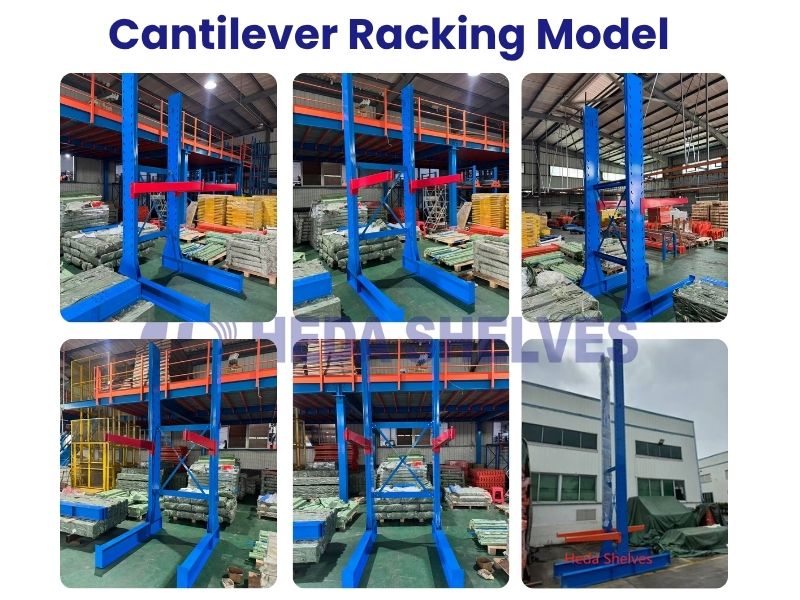
Walk into any lumber yard, steel distribution center, or furniture warehouse and you'll likely see rows of steel uprights with horizontal arms jutting out - no front columns blocking the aisle, no beams running across the face. That's cantilever racking.
Cantilever Rack systems have no vertical posts on the front face. This open design gives forklift operators unobstructed horizontal access to materials of virtually any length. Think of it like a tree: the upright column is the trunk, and the arms extending outward are the branches holding your materials.
This design solves a very specific problem. If your warehouse stores items longer than 8–10 feet (2.4-3 m): sheet metal, PVC pipe, wooden planks, rolled carpet, or sofas, standard pallet racks are the wrong tool. Materials overhang, balance becomes unstable, and the risk of damage or injury goes up fast.
Cantilever racking was engineered specifically for these scenarios.
Component of Cantilever Racking
Before choosing a system, it helps to understand what you're actually buying. Every cantilever rack is made up of three core components:
1. Uprights (Vertical Columns)
Uprights are manufactured from either structural I-beam steel (heavy duty) or roll-formed C-channel (lighter duty). Heights typically range from 6 feet to 20+ feet. Along the upright face, holes are punched at 1″, 3″, or 4″ vertical intervals - these allow arms to be repositioned at different heights as your inventory changes.
Each upright is anchored to a base plate that must be bolted directly into the concrete floor. Capacity per upright ranges from 10,000 lbs on lighter roll-form systems up to 36,000+ lbs per side on heavy structural systems.

2. Arms (Cantilever Beams)
The arms are the horizontal extensions that physically hold your materials. They come in lengths from 12 inches to 60 inches (some manufacturers offer longer custom arms) and slot into the upright using hairpin-style locking pins for fast, tool-free adjustment.
Arms can be straight (for flat, stable loads like plywood or lumber) or inclined at roughly 20° (for round stock like pipes or rods that might roll off a flat surface).
Some arms also include end stops or lips to prevent loads from sliding off accidentally.

3. Braces (Sway Braces)
Braces connect uprights horizontally and diagonally to prevent the system from swaying or tipping under load. They don't hold inventory - their job is purely structural. Taller systems require proper bracing sets to maintain structural integrity and prevent swaying under load.
The right brace pattern (2B, 3B, 4BX, etc.) depends on the height of your uprights, so always follow the manufacturer's specification.

Type of Cantilever Racking
The two main categories are defined by their construction method and intended environment.
Standard Steel Cantilever Rack
Steel Cantilever Rack is made from cold-rolled formed steel. It's lighter, less expensive, and faster to assemble since arms connect to uprights with simple pins rather than bolts. This type is primarily designed for indoor, climate-controlled environments. Check our Light Duty Cantilever Rack here.
Best suited for: furniture warehouses, retail storage, light manufacturing, textile storage, indoor lumber (lighter species), and showrooms.
Key specs:
- Arm capacity: 300–1,500 lbs per arm
- Max height: typically 10–12 feet
- Connection: boltless pin system
- Environment: indoor only
- Price (starter unit): $600–$1,400
If your operation stores sofas, flat-pack furniture, fabric rolls, or light construction materials in a covered warehouse, roll-form is likely the right fit.

Hot-Dip Galvanized Cantilever Rack
Structural cantilever rack or called heavy duty cantilever rack is built from I-beam steel, significantly thicker and heavier than roll-form. Connections are bolted rather than pinned, making the system more rigid and impact-resistant. The hot-dip galvanized cantileve rack coats the steel in a layer of zinc, providing long-term protection against rust, humidity, and outdoor weather.
Best suited for: lumber yards, steel distribution, heavy manufacturing, pipe storage, outdoor storage yards, and any environment with moisture, rain, or temperature extremes.
Key specs:
- Arm capacity: 1,500–6,600+ lbs per arm
- Max height: 20+ feet
- Connection: bolted hardware
- Environment: indoor and outdoor
- Price (starter unit): $1,200–$3,800+
For any operation running forklifts in a yard, storing steel in a covered but unheated facility, or handling loads above 1,500 lbs per arm, structural cantilever with hot-dip galvanizing is the correct choice.
When choosing cantilever racking materials, consider your specific needs. For lighter applications involving sheet metal or other heavy items, roll-form cantilever systems offer a cost-effective option. However, for maximum durability with truly heavy items, structural hot-dip galvanized cantilever racking is the better choice, especially for outdoor or high-load environments.

Benefits of Cantilever Racking
Why invest in cantilever rather than continuing to floor-stack or improvise with pallet racks? Here are the real operational benefits:
- Maximize Usable Storage Space By storing materials vertically across multiple arm levels, you free up floor space that floor stacking simply cannot recover. Most operations see a 10–40% increase in usable storage capacity within the same square footage.
- Complete Product Accessibility (100% Selectivity) Every item on every arm is independently accessible. You never need to move one item to reach another. This speeds up picking, reduces handling damage, and simplifies inventory management significantly.
- Flexibility That Grows With Your Business Arms reposition on vertical increments without tools. Mix different arm lengths on the same upright to accommodate different product sizes. Add uprights and arms as your inventory grows. The system adapts to your building material or other item picking.
- Significant Product Damage Reduction Floor stacking crushes bottom-layer materials and creates unstable piles. Cantilever systems store each layer independently, reducing product damage by 20–35% in most operations.
- Safety and OSHA Compliance Organized, stable storage reduces the risk of tip-overs, falling materials, and forklift accidents. Properly designed cantilever systems meet OSHA 29 CFR 1910.176 requirements for safe material storage.
Factors to Choose the Right Cantilever Racking
This is the core decision framework. Five factors determine the right system for your operation.
1. Storage Needs
Start with your product, not the rack. What are you storing? How long is it? Is it stored indoors or outdoors? Does it need to handle weather exposure?
Standard Steel Cantilever Rack is the right choice when:
- Products are stored in a dry, temperature-controlled building
- Loads per arm stay under 1,500 lbs
- Products include furniture, textiles, light lumber, or interior building materials
- Budget is a primary concern and outdoor durability is not required
Hot-Dip Galvanized (Structural) Cantilever Rack is the right choice when:
- Storage is outdoors or in an open, exposed structure
- Loads exceed 1,500 lbs per arm
- The environment involves humidity, rain, temperature swings, or chemical exposure
- Products include heavy lumber, steel, pipe, or construction materials
- Long-term durability is a priority over upfront cost savings
Load Capacity
This is the most critical factor and the most commonly miscalculated. Overloading cantilever racks is the leading cause of structural failure, and it's entirely preventable.
How to calculate required arm capacity:
Required Arm Capacity = Total Load Weight ÷ Number of Arms Supporting That Load
The common dimension for any material storage
| Any Inventory | Load Weight | Arms Supporting | Required/Arm | With Safety Margin |
| Light furniture | 800 lbs | 4 arms | 200 lbs | 250 lbs min |
| Plywood bundles | 2,400 lbs | 4 arms | 600 lbs | 750 lbs min |
| Steel bar stock | 4,000 lbs | 4 arms | 1,000 lbs | 1,250 lbs min |
| Heavy pipe | 6,000 lbs | 4 arms | 1,500 lbs | 1,875 lbs min |
Important variables that reduce effective arm capacity:
- Longer arms reduce rated capacity due to increased leverage moment
- Dynamic loading (forklift impact during placement) adds stress beyond static weight
- Uneven weight distribution across arms causes premature wear or failure
- Taller uprights may carry lower effective capacity ratings
Arm Size
Arm length determines whether your materials are properly supported. The rule is straightforward: your arms must be at least as long as the depth of your product.
If you're storing 48-inch-wide plywood sheets, you need 48-inch arms minimum. Shorter arms will cause the load to overhang the arm tip, creating a leverage point that can bend the arm or cause the load to slip.
Standard arm lengths available: 12", 18", 24", 30", 36", 42", 48", 54", 60"
Proper arm lengths are critical for safe loading and unloading. Arms should extend slightly beyond the depth of your materials, making it easier to store long items without overhang risks.

| Guidelines by product type: | |
| Product | Recommended Arm Length |
| Dimensional lumber (standard) | 36"–48" |
| Plywood / OSB sheets | 48" minimum |
| Steel bar stock | 36"–48" |
| Steel pipe / tubing | 36"–60" depending on diameter |
| Furniture (sofas, tables) | 30"–48" |
| Carpet / fabric rolls | 36"–48" (inclined arms recommended) |
For round or cylindrical materials (pipe, rods, carpet rolls), inclined arms at 15–20° prevent items from rolling off the arm tip. Always add end stops when there's any risk of the load sliding forward.
For lighter applications involving sheet metal or other heavy items, roll-form cantilever systems offer a cost-effective option. However, for maximum durability with truly heavy items, structural cantilever is preferred.
Rack Height
Height determines how many arm levels you can run and how much vertical storage you can achieve. Your ceiling clearance is the starting point, but it's not the only constraint.
Practical height guidelines:
You need a minimum of 18–24 inches of clearance between your highest load and the ceiling, sprinkler heads, or HVAC equipment
OSHA and fire codes in most US jurisdictions require at least 18" of clearance below sprinkler heads
Forklift mast height must be able to reach your top arm level comfortably - check your equipment's maximum lift height with load
| Height selection by operation type: | ||
| Operation Type | Typical Upright Height | Notes |
| Small retail/showroom | 6'–8' | Often manual loading |
| Standard warehouse | 10'–12' | Standard sit-down forklift access |
| High-bay warehouse | 14'–20' | Requires reach truck or high-mast forklift |
| Outdoor lumber yard | 10'–16' | May need extended mast forklifts |
Roll-form systems are generally limited to 10–12 feet. If you need height above that, you'll need structural cantilever. For any system above 12 feet, it's worth getting an engineer to review the design and anchor specifications.
Spacing Between Arms
Arm spacing (the vertical distance between arm levels) directly impacts how many products you can store per upright and how efficiently your forklift operators can load and unload.
The right spacing depends on the height of your stored products plus the clearance your forklift needs to maneuver the load safely.
| Product | Product Height | Recommended Arm Spacing |
| 2×4 lumber bundle | 12" | 18"–20" |
| 4×8 plywood bundle | 4"–6" | 10"–12" |
| Steel bar bundle | 8" | 14"–16" |
| Large furniture (sofas) | 36"–40" | 44"–48" |
| Rolled carpet | 24"–36" | 32"–44" |
Arms on most cantilever systems adjust on 1"–4" vertical increments, so you can fine-tune spacing to match your exact product dimensions. This adjustability is one of the key advantages of cantilever over fixed shelving, you're not locked into a single configuration as your inventory mix changes.
How to Order the Right Cantilever Racking: Step by Step
Follow this sequence to avoid the most common and costly ordering mistakes.
- Step 1: Measure Your Products Document the length, width, height, and weight of every SKU you intend to store. Include your heaviest loads and your longest materials. These figures drive every decision that follows.
- Step 2: Assess Your Space Measure your warehouse or yard: available floor area, ceiling height (to underside of structure and to sprinkler heads), aisle width requirements, and proximity to walls. Note whether the storage location is indoor, outdoor, or partially exposed.
- Step 3: Determine Single-Sided vs Double-Sided Single-sided units have arms on one side only - ideal for placement against walls or building perimeters. Double-sided units have arms on both sides, maximizing efficiency in open aisles. If you have a free-standing row accessible from both sides, double-sided delivers more storage per square foot of floor space.
- Step 4: Calculate Load Capacity Requirements Using the formula above (load ÷ arms × 1.25 safety margin), determine the minimum arm capacity you need. Also calculate upright capacity: multiply arms per side × load per arm × number of arm levels, then verify the upright rating exceeds this total.
- Step 5: Select Your System Type Based on your environment and load requirements: roll-form standard steel for light indoor applications, structural hot-dip galvanized for heavy loads, outdoor use, or harsh environments.
- Step 6: Specify Arm Length, Height, and Spacing Select arm length to match or exceed your product depth. Set upright height based on available ceiling clearance minus the required 18–24 inch overhead buffer. Calculate arm spacing for each product type you'll be storing.
- Step 7: Plan Forklift Compatibility Verify your forklift can reach your top arm level under load. Confirm aisle width provides adequate turning radius (most forklifts need 10–13 feet for standard cantilever aisles, though this varies by equipment type).
- Step 8: Request a Formal Quote with Engineering Documentation Work with a qualified supplier who will provide: a system layout drawing, load capacity certification, anchor specifications for your specific floor, and compliance documentation. Never purchase based on a verbal quote alone.
- Step 9: Plan Installation Hire experienced installers familiar with cantilever racking systems. All uprights must be floor-anchored per manufacturer specifications - typically 5/8" or 3/4" wedge anchors with 4–6" embedment into reinforced concrete. Do not skip anchors or reduce torque specifications.
- Step 10: Label and Train Post load capacity signs on every bay before the system goes live. Train all forklift operators on proper loading technique, maximum arm capacities, and what to report if they observe damage.
Need another type of cantilever rack?
Learn More: Ultimate Guide: How to Choose The Right Cantilever Racking System
Conclusion
If you finding a material storage solution, cantilever racking is the best choice, while indoor or outdoor environment. When you manage a normal warehouse store material indoor just choose the steel cantilever rack with any load capacity section. But outdoor storage you should order the hot-dip galvanized cantilever rack, shed or not-shed available.
Have any storage or layout question? Have drawing for custom cantilever rack? Contact HEDA SHELVES. We offer one-stop solution for your material storage.
FAQ
What is cantilever racking best used for?
Cantilever racking is purpose-built for long, bulky, or irregularly shaped materials that don't work on standard pallet racks: dimensional lumber, plywood, steel bar stock, pipe and tubing, rolled carpet, furniture, (any material exceeding 8–10 feet in length). Its open-front design eliminates vertical post obstructions, enabling clean horizontal access.
What's the difference between single-sided and double-sided cantilever?
Single-sided units have arms extending from one face only and are designed for placement against walls or building edges. Double-sided units have arms on both faces, allowing access from both sides of the aisle. Double-sided configurations deliver higher storage density in open aisles because both sides are utilized.
Do I need hot-dip galvanizing if I'm indoors?
Not necessarily. Standard painted structural cantilever works well in dry, temperature-controlled indoor environments. Hot-dip galvanizing is recommended when the storage area is outdoors, partially exposed, subject to moisture, humidity, or temperature fluctuations, or in environments where corrosive materials are handled. For standard indoor warehouses, a quality powder-coat or paint finish is typically adequate.
Can cantilever racks be used outdoors?
Yes, structural cantilever with hot-dip galvanizing is designed for outdoor use. It's commonly used in lumber yards, steel distribution facilities, and construction material storage yards. Outdoor systems should be inspected more frequently for anchor integrity and surface corrosion, particularly in coastal or high-humidity regions.
Do cantilever racks need to be anchored to the floor?
Yes - always. Every upright must be anchored to the concrete floor with the specified hardware. This is required by OSHA, by virtually all manufacturers (unanchored systems void the warranty), and by basic structural safety. Your concrete slab should be at least 4–6 inches thick and capable of supporting the concentrated load. Do not install cantilever racking on cracked, damaged, or inadequately thick slabs without an engineering assessment.
How do I know if I need structural or roll-form cantilever?
If any of the following apply, choose structural: loads exceeding 1,500 lbs per arm, outdoor or partially exposed storage, high-bay requirements above 12 feet, environments with moisture or temperature extremes, or heavy industrial applications. If all of the following apply, roll-form may be sufficient: indoor climate-controlled environment, loads under 1,500 lbs per arm, height under 12 feet, and lighter product categories like furniture or textiles.
How often should cantilever racking be inspected?
Operators should visually scan the system daily before each shift for obvious damage, overloads, or displaced loads. Supervisors should conduct a more thorough inspection weekly, checking arm connections, upright plumb, and floor anchor integrity. A qualified inspector should perform a full professional assessment at least annually, with documentation kept on file.