


Is your warehouse bursting at the seams? Are rising labor costs eating into your profits? Radio shuttle racking offers a powerful solution, unlocking dramatic improvements in storage density and operational efficiency. Pallets moving autonomously, maximizing every inch of space, and significantly reducing your reliance on manual labor.
In this blog, I will introduce you to a complete list of radio shuttle racking, detailing radio shuttle racking how it work, pons&cons, application, including what they are, how they work, and how to choose them wisely. This can help mitigate the risk of being misled by considering ASRS System or Semi-automatic system.
Carefully read and follow us if you find this helpful.
Definition of radio Shuttle Racking
Radio shuttle racking is an automated storage solution that uses a shuttle-like device to move pallets within racking systems. This technology allows for efficient storage and retrieval of goods in high-density warehouses, optimizing space and reducing labor costs.
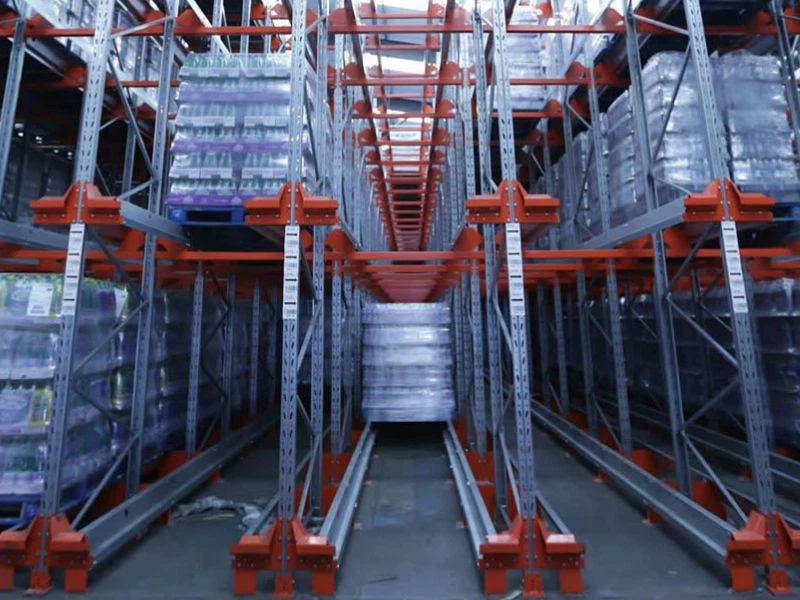
Operation principle Radio Shuttle Racking
Radio Shuttle Racking represents a transformative advancement in high-density storage solutions, combining semi-automated technology with optimized spatial efficiency. This system utilizes remotely controlled electric shuttles that traverse storage channels to store and retrieve pallets, significantly reducing reliance on manual forklift operations.
By enabling both FIFO (First In, First Out) and LIFO (Last In, First Out) inventory management strategies, Radio Shuttle Racking maximizes storage depth-often exceeding 60 meters-while enhancing operational safety and throughput.
Its integration of lithium-powered shuttles, precision rail systems, and intuitive control interfaces allows warehouses to achieve up to 90% space utilization, making it particularly advantageous for cold storage, food distribution, and industries requiring rapid inventory turnover.
Structural Components of Radio Shuttle Racking
Racking Framework and Rail System
The foundation of Radio Shuttle Racking lies in its robust structural design. Upright frames constructed from high-strength steel provide vertical support, while horizontal beams connect these frames to form storage channels. Guide rails, typically made from reinforced steel, are installed within these channels to facilitate the smooth movement of the shuttle. These rails feature ledges that prevent lateral displacement of the shuttle during operation.
The racking system's modularity allows customization to warehouse dimensions, with channel depths ranging from 5 to 70 pallet positions and heights exceeding 40 meters, depending on forklift reach and ceiling constraints.
Shuttle Unit and Propulsion Mechanism
The shuttle, weighing between 190–250 kg, serves as the system's operational core.
Powered by lithium-ion batteries (24V/60–80Ah), it achieves travel speeds of 0.6–1.2 m/s when loaded, with a lifting mechanism capable of raising pallets by 22 mm to disengage from rails.
Four polyurethane wheels ensure low-friction movement, while onboard sensors detect pallet positions to prevent collisions. The shuttle's control unit communicates via 433 MHz radio frequency or Wi-Fi, allowing operators to manage multiple shuttles simultaneously through a single tablet interface.
How Does a Shuttle Pallet Racking System Work?
Shuttle Deployment: A forklift positions the shuttle at the target channel's entrance, aligning it with the guide rails. Operators secure the shuttle via a tablet-controlled locking mechanism.
Pallet Placement: The forklift deposits a pallet onto the rails at the channel's mouth. Optical sensors verify centering before engagement, preventing misalignment.
Automated Transport: Upon receiving a wireless command, the shuttle lifts the pallet, disengages from the rails, and transports it to the deepest available position. This cycle repeats until the channel is filled, with the shuttle autonomously returning after each deposit.
Performance and Comparative Advantages
Radio Shuttle Racking Systems represent a paradigm shift in high-density warehousing, combining semi-automated technology with structural innovation to optimize storage efficiency.
As a three-component system comprising forklifts, rack structures, and electric shuttles, it enables precise pallet handling while minimizing manual intervention.
The system's design prioritizes seamless integration of mechanical and control elements, achieving storage densities up to 90% and reducing operational costs by 30–40% compared to conventional drive-in racking.
Throughput Efficiency
Shuttle systems achieve 30–50 cycles per hour, outperforming manual drive-in racking by 200%. A Mecalux case study documented a 10,000-pallet facility increasing daily throughput from 800 to 1,300 pallets while reducing labor costs by 40%.
Spatial Optimization
By eliminating intra-lane forklift traffic, shuttle systems utilize 85–90% of available space versus 60–65% for selective pallet racking. A 70-pallet-deep channel can store 45 EURO pallets compared to 22 in drive-in systems.
| Metric | Shuttle System | Drive-In Racking | Selective Racking |
|---|---|---|---|
| Max Lane Depth | 70 pallets | 20 pallets | 1 pallet |
| Cycle Time | 90 seconds | 150 seconds | 120 seconds |
| Space Utilization | 90% | 75% | 60% |
| FIFO/LIFO Support | Both | LIFO only | FIFO only |
Radio Shuttle Applications
Cold Storage and Freezer Warehouses
Radio Shuttle systems excel in cold storage environments (-30°C to +40°C), where energy efficiency and space maximization are critical. By minimizing airspace through compact storage, these systems reduce cooling costs by 25–30% while maintaining strict temperature control.
High-Density Storage for Homogeneous SKUs
Facilities managing large volumes of a single SKU benefit from deep-lane configurations (up to 70 pallets per channel), achieving 85–90% space utilization compared to 60–65% in conventional racking.
Seasonal Demand and Buffer Storage
Radio Shuttle systems adapt to fluctuating demand through flexible FIFO/LIFO configurations, ideal for seasonal merchandise or temporary storage.
Warehouses with Space Constraints
Facilities facing spatial limitations leverage Radio Shuttle systems to double storage capacity without physical expansion.
Industries with High Product Uniformity
Businesses handling homogeneous goods-such as food production, beverages, and consumer packaged goods-leverage Radio Shuttle systems for batch management:
- High-Volume SKUs: Each channel can store a different SKU, enabling precise inventory grouping.
- Automotive Sector: Storage of bulk components (e.g., tires, engines) with minimal handling errors.
Key Advantages and Disadvantages of Shuttle Pallet Racking
Advantages of Shuttle Pallet Racking
Space Optimization and Storage Density
Shuttle systems achieve 85–90% space utilization, far exceeding traditional drive-in (70–75%) or selective racking (60–65%). By eliminating intra-lane forklift aisles, they enable deep-lane configurations of up to 70 pallets per channel, nearly doubling storage capacity in the same footprint. For example, a 30-meter channel can store 45 EURO pallets compared to 22 in drive-in systems, maximizing vertical and horizontal space.
Operational Efficiency and Throughput
Automated shuttles reduce forklift dependency, cutting travel times by 70% and enabling 30–50 cycles/hour, a 200% improvement over manual systems13. Case studies, such as a Mecalux implementation, show facilities increasing daily throughput from 800 to 1,300 pallets while reducing labor costs by 40%15. Operators control multiple shuttles via tablets or remotes, streamlining workflows and minimizing human error.
Inventory Management Flexibility
Shuttle systems support both FIFO and LIFO strategies, making them versatile for perishables and non-perishables. FIFO configurations use dual-access aisles for stock rotation, reducing spoilage in cold storage by 30%, while LIFO optimizes single-aisle density for bulk goods. Real-time RFID tracking enhances accuracy, minimizing stock discrepancies.
Reduced Product and Racking Damage
By limiting forklift access to storage lanes, shuttle systems lower product damage rates to 0.2% annually (vs. 4.7% in traditional systems) and reduce rack collisions by 60%. Sensors and guided rails prevent misalignment, while compact pallet spacing minimizes load shifts during transport.
Cold Storage Performance
Lithium-ion shuttles operate reliably in temperatures as low as -30°C, with corrosion-resistant components ensuring longevity. Compact storage reduces cooling costs by 25–30% by minimizing airspace, as demonstrated in Burro De Paoli's butter storage facility.
Labor and Energy Savings
Automation reduces staffing needs by 40–50%, with one operator managing up to 18 shuttles. Energy-efficient shuttles offer 8–12 hours of operation on a 3-hour charge, cutting fuel costs and carbon footprints.
Disadvantages of Shuttle Pallet Racking
High Initial Investment
Upfront costs range from $1,200–$2,000 per pallet position, significantly higher than drive-in or selective racking. Expenses include specialized racking, shuttles, control systems, and installation. For example, Alibaba listings show shuttle systems priced at $17,500–$18,000 for advanced models.
Dependence on Technology
System functionality hinges on uninterrupted tech performance. Battery failures, software glitches, or sensor malfunctions can halt operations, requiring specialized maintenance teams. Breakdowns in automated guided vehicles (AGVs) may delay workflows for hours.
Limited SKU Flexibility
Shuttle systems excel with homogeneous products but struggle with mixed SKUs. Facilities handling diverse inventory face inefficiencies, as channels typically store one SKU. For example, automotive parts warehouses benefit, while e-commerce hubs with varied items may not.
Maintenance Complexity
Regular upkeep includes rail alignment checks, battery replacements, and sensor recalibration. Rail joints must maintain gaps <5 mm to prevent shuttle derailment, and worn wheels require frequent inspection813. Maintenance costs can rise by 15–20% annually compared to static systems.
Structural and Operational Constraints
Rigid Design Requirements: Rails and racks demand precision engineering, with beam deflection limited to ≤1:1,000 under load. Floor flatness tolerances must be ±3 mm/m², complicating retrofits in older warehouses.
Rescue Delays: Shuttle failures in deep lanes require manual retrieval, extending downtime
| Parameter | Shuttle Racking | Drive-In Racking | Selective Racking |
|---|---|---|---|
| Max Depth | 70 pallets | 20 pallets | 1 pallet |
| Space Utilization | 85–90% | 70–75% | 60–65% |
| FIFO/LIFO Support | Both | LIFO only | FIFO only |
| Upfront Cost | $$$ | $$ | $ |
| Maintenance Cost | High | Moderate | Low |
Choosing the Right Pallet Shuttle System
STEP 1: Warehouse Layout and Spatial Constraints
Aisle Width: Systems like 2-way shuttles require minimal aisle space (1.5–2m), while 4-way or mother-child ASRS may need wider aisles for lateral movement.
Ceiling Height: Vertical storage capacity depends on racking height. Systems like Jungheinrich's Under Pallet Carrier (UPC) optimize vertical space with heights up to 40m.
Floor Load Capacity: Ensure floors support dynamic loads from shuttles (190–250 kg) and pallets (1,500 kg max)
sTEP 2: ensure your Inventory Requirement
SKU Diversity:
Homogeneous SKUs: 2-way shuttles (e.g., Maxrac Four-way) excel for low-SKU, high-volume storage17.
Mixed SKUs: Mother-child ASRS manages multiple SKUs across lanes using a "mother" carrier and "child" shuttles710.
Pallet Dimensions: Verify shuttle compatibility with pallet sizes (e.g., EURO, industrial) and weight capacities (typically 1,500 kg)
Step 3 Choose Operational Strategy
FIFO vs. LIFO:
FIFO: Requires dual-access aisles; ideal for perishables (e.g., Mecalux cold storage systems).
LIFO: Single-aisle configurations maximize density for non-perishables.
Automation Level:
Semi-automated: Forklift-dependent 2-way systems (lower upfront cost).
Fully automated: 4-way or mother-child ASRS with IoT integration (higher ROI)
Step 4 : Environmental and Structural Factors
Temperature: Cold storage (-30°C) demands corrosion-resistant components (e.g., Avanta's BZ shuttle model).
Seismic Compliance: DIN EN 16681-certified systems ensure stability in seismic zones
Why Choose Heda Shelves
At Heda Shelves, we understand that optimizing your warehouse storage is crucial for your business's success. With years of experience in providing comprehensive material handling solutions, we specialize in designing and installing high-quality radio shuttle racking systems tailored to your specific requirements.
Our team of experts will work closely with you to assess your warehouse layout, inventory needs, and operational goals. We provide end-to-end services, from initial consultation and design to engineering, installation, and ongoing support. We prioritize quality and reliability, ensuring that your radio shuttle racking system delivers maximum efficiency and performance.
Ready to transform your warehouse storage? Contact Heda Shelves today for a free consultation and customized storage solution design.