


KEY TAKEAWAYS
- Structural integrity in pallet racking relies heavily on surface pretreatment; applying powder coating over raw, unwashed steel guarantees rapid delamination and corrosion.
- Acid-washing (pickling) chemically strips mineral oils, cutting fluids, and mill scale left behind during the steel roll-forming process, ensuring a pristine substrate.
- A rigorous multi-stage chemical wash creates a micro-porous surface that allows thermosetting powder to cross-link securely with the steel, extending the asset's lifecycle in high-humidity logistics centers.
- Physical abrasion (shot blasting) and chemical pretreatment (acid washing) serve distinct manufacturing roles, but chemical washing remains superior for treating the complex internal geometries of racking uprights.
How Can You Ensure the Safety of Pallet Racking?
Start with the manufacturing process to choose a stable and durable racking frame.
When investing in warehouse racking, the first thing to consider is the manufacturing process of the components.
This article will explore the manufacturing process of warehouse racking, surface treatment techniques, and how to select durable pallet racking through surface treatment.
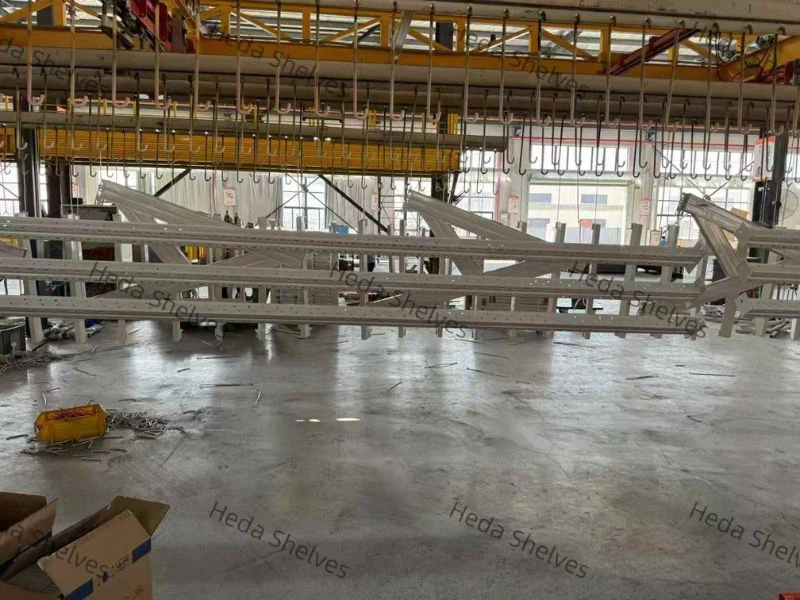
Racking Production Process phases:
HOW PALLET RACKING MADE IN HEDA SHELVES FACTORY
Raw Material of Industrial Racking
Pallet racking starts with certified high-tensile steel coils, typically 1.5 mm to 3.0 mm thick, sourced to ASTM or equivalent standards. These coils deliver the yield strength required for uprights rated at 10,000–30,000 pounds per bay in selective systems and higher capacities in drive-in configurations. Material selection directly determines load-bearing capacity and resistance to impact from forklifts operating 24/7 in distribution centers. Any deviation in steel chemistry or thickness creates weak points that no surface treatment can fully compensate for.
Profiling process
Coils feed into precision roll-forming lines that shape upright columns and box beams in a single continuous pass. Automated punching creates teardrop or keyhole slots at 75 mm or 100 mm intervals, allowing beam height adjustment without compromising column strength. Roll-forming maintains tight tolerances-±0.5 mm across the entire profile-so uprights align perfectly during installation. This step also introduces the complex internal channels and stiffening ribs that increase torsional rigidity while demanding thorough pretreatment later.
Welding process
Automated robotic welding joins beam end connectors to the box sections and reinforces upright base plates. Continuous seam welds and spot welds follow strict ANSI MH16.1 protocols to achieve full structural integrity under static and dynamic loads. Post-weld inspection removes slag and spatter that could otherwise trap contaminants and cause coating defects. At this stage every component still carries residual drawing oils and light scale from profiling and forming.
Finish of the racking components
Before any coating, every upright, beam, and accessory enters the pretreatment line. Acid washing removes all fabrication residues, followed by rinsing and phosphating. This chemical finish creates the micro-porous layer essential for powder adhesion. Skipping or shortening this phase leaves microscopic oil films that cause immediate delamination once the racking enters service in warehouses.
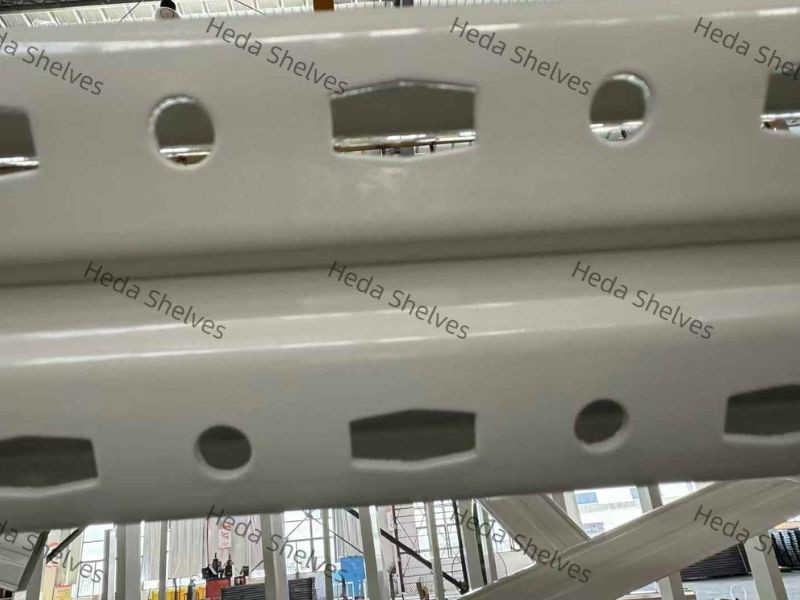
200°C high-temperature curing
After electrostatic powder application, parts move into convection ovens held at a consistent 200 °C. The thermosetting powder melts, flows, and cross-links into a uniform 60–80 μm film during a controlled 10–15 minute dwell. Precise temperature control prevents under-curing (soft film) or over-curing (brittleness). The result is a tough, chemically resistant surface that withstands daily abrasion, moisture, and chemical exposure in logistics warehouses.
HOW Pallet Racking POWDER-COATING WORKS
Powder coating uses an electrostatic spray system to apply a dry blend of polyester or epoxy-polyester resin, pigments, and additives. Negatively charged particles adhere evenly to the grounded steel, covering every contour of the profiled uprights and welded beams.
The 200 °C curing cycle then transforms the powder into a continuous, pinhole-free layer that resists chipping, scratching, and corrosion far better than solvent-based paints. Rack Manufacturers Institute data confirm powder-coated finishes maintain integrity under repeated forklift impacts that would quickly degrade liquid-painted surfaces.
Find any trustworth racking system in brands? Read Our Top Manufacturer Guide
WHY ACID WASHING BEFORE POWDER-COATING
Steel emerging from roll-forming and welding retains mineral oils, cutting fluids, and mill scale. These residues block mechanical interlocking and chemical bonding. Acid washing (pickling) immerses or sprays the components in a controlled phosphoric or hydrochloric acid solution that dissolves contaminants without etching the base metal.
A subsequent zinc-phosphate stage deposits a crystalline conversion layer only 5–10 μm thick. This layer chemically anchors the powder, creating a bond that survives vibration, thermal cycling, and high-humidity conditions typical in distribution centers.
Benefit of Acid Washing in Heavy-Duty Applications
- Maximum Adhesion Force: Stripping the oil exposes the reactive steel molecules, allowing the subsequent phosphating layer to grip the metal permanently.
- Internal Cavity Protection: Racking uprights feature hollow, tubular, or C-channel geometries. Liquid acid flows through these internal spaces, removing oil and rust from the inside out.
- Corrosion Resistance Amplification: A pristine surface ensures a uniform coating thickness without pinhole defects. This uniform shell actively repels moisture, extending the system's operational lifespan by decades.
- Impact Tolerance: A properly bonded powder coat flexes with the steel during warehouse operations rather than flaking off upon impact.
ACID-WASHING VS SHOT BLASTING (Abrasive Blasting)
When comparing surface preparation techniques, manufacturers debate chemical immersion versus mechanical abrasion (often referred to in heavy industry contexts akin to ball milling or shot blasting). Both aim to clean the metal, but their applications in warehouse racking differ significantly.
| Feature | Acid-Washing (Chemical Pickling) | Shot Blasting (Physical Abrasion) |
| Mechanism | Chemical dissolution of oils and oxides. | High-velocity steel shot physical impact. |
| Oil Removal | Exceptional. Saponifies and dissolves lubricants. | Poor. Impact can sometimes drive oils deeper into metal pores. |
| Internal Surface Reach | Total coverage. Liquids flow through the complex internal geometry of uprights. | Limited to line-of-sight. Cannot clean the inside of rolled tubes or C-channels. |
| Surface Profile | Creates a micro-porous surface ready for phosphating. | Creates a rough, etched profile suitable for thick industrial wet paint. |
| Material Distortion | None. Safe for thinner gauge steel profiles. | High risk of warping or distorting thin-gauge metal due to kinetic impact. |
For the specific architectural geometries of pallet racking-which rely heavily on internal structural channels and thin-gauge, high-yield steel-acid washing proves functionally superior for achieving a reliable powder-coat bond.
How HEDA SHELVES Keep Top Quality in Warehouse Racking Produce
After working in warehouse racking manufacturing for more than 15 years, one issue we repeatedly encountered was powder coating peeling off from upright frames within one or two years of installation, especially in humid coastal warehouses. The problem was not the steel strength itself, but insufficient surface pretreatment before powder coating. Many customers only focused on load capacity and ignored how the rack surface was processed during manufacturing.
In one production batch of heavy-duty selective pallet racking, we found that several uprights developed coating bubbles after salt-spray testing. After checking the process records, we discovered that the acid-washing line temperature had fluctuated during continuous production, leaving residual rolling oil inside the upright channels. Because pallet rack uprights have narrow internal geometries formed during roll-forming, incomplete cleaning can easily happen if the pretreatment time is shortened to increase output.
To solve this, we adjusted the pretreatment sequence by extending the degreasing and phosphating cycle and added random adhesion testing before powder coating. We also tightened oven temperature control during the 200°C curing stage to avoid under-curing. After the adjustment, the coating adhesion test and salt-spray performance became stable, and the racks performed much better in long-term warehouse use. In my experience, the durability of a racking system depends as much on pretreatment and curing as on the steel thickness itself
How HEDA SHELVES racking long life
HEDA SHELVES racking long life stems directly from the complete acid-washing, phosphating, and 200 °C powder-curing sequence applied to every batch. Uprights and beams retain full structural and cosmetic integrity well beyond industry averages, delivering lower maintenance costs and higher uptime for warehouse owners and logistics managers.
Worry About Shipping Safety? Check Our Factory Online
Conclusion
Every phase of racking production from raw material selection through profiling, welding, acid washing, and 200 °C curing-must align for the final system to deliver decades of reliable service. Surface pretreatment is the decisive step that prevents premature coating failure and protects load-bearing capacity in demanding distribution environments. Warehouse and distribution center project teams that specify full chemical pretreatment secure the longest service life and lowest total ownership cost.
HEDA SHELVES systems incorporate these exact processes to meet the strictest performance requirements. Contact our sales team today to review specifications tailored to your next warehouse project.
Check Our Racking System Packing Process
FAQ
What is the purpose of acid washing in pallet racking production?
Acid washing removes all oils, cutting fluids, and mill scale from profiled and welded steel before powder coating, creating the chemically active surface required for permanent adhesion.
Why is 200 °C curing critical for powder-coated racking?
The 200 °C temperature fully melts and cross-links the thermosetting powder into a durable 60–80 μm film that resists chipping, chemicals, and abrasion in high-traffic logistics facilities.
How does acid washing improve heavy-load performance of racking uprights?
It prevents delamination under dynamic forklift impacts and static loads over 20,000 pounds per bay by forming a phosphate layer that bonds the powder coating securely to the steel substrate.
Is shot blasting sufficient for pallet racking surface treatment?
Shot blasting provides mechanical profile but lacks the chemical activation needed for internal channels and long-term corrosion resistance; acid washing remains superior for most warehouse applications.
How long can properly pretreated powder-coated racking last?
With full acid washing and 200 °C curing, powder-coated pallet racking typically delivers 15–25 years of service in standard distribution center conditions, far exceeding mechanically cleaned alternatives.
What should warehouse managers look for when specifying racking finish?
Insist on documented acid-washing and phosphating steps, 60–80 μm powder thickness, and 200 °C curing data to guarantee adhesion, corrosion resistance, and full load capacity retention.