


Mobile shelving, also known as compact mobile storage or high-density rolling racks, is one of the smartest ways to solve the number one warehouse and archive problem. Facilities often run out of space without expanding their building. By mounting shelving units on wheeled carriages that glide along floor tracks, you eliminate fixed aisles. This change turns wasted space into usable storage.
The result is up to 80 percent more storage capacity in the same area. Most commercial warehouse storage projects see full ROI within 12 to 18 months.
This guide walks you through everything you need to know to decide if mobile shelving fits your needs and how to make it work.
Key Takeaway
-
Mobile shelving packs up to 80% more storage into the same footprint by eliminating fixed aisles.
-
You get three easy-to-use types-manual, mechanical assist, or powered-to match your load and daily access needs.
-
It costs more upfront than static shelving but pays for itself fast through space savings, lower rent, and better organization.
-
Perfect for offices, warehouses, libraries, hospitals, museums, retail, and heavy industrial use.
-
Systems last 20+ years with simple maintenance and deliver quick ROI for any business tight on space.
What is Mobile Shelving
Mobile shelving consists of steel shelving bays mounted on heavy-duty carriages that move along flush-mounted floor tracks. A simple hand-crank or electric motor opens a single access aisle wherever you need it. This differs from traditional static racking because the entire system compacts when not in use.
Since 2001, HEDA has designed and installed over 5,000+ warehouse racking projects worldwide. These projects range from small corporate archives to large pharmaceutical warehouses.
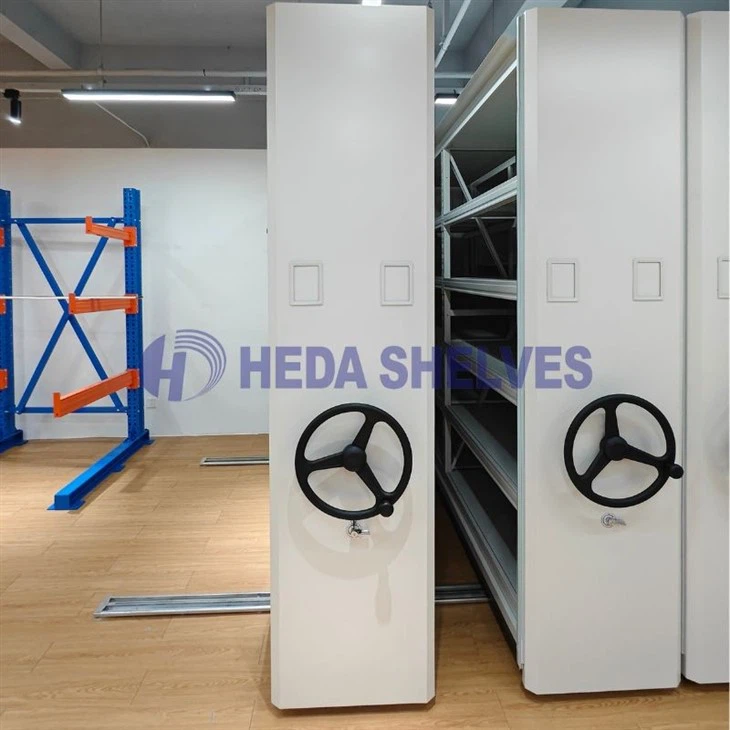
How does a mobile shelving system work?
Shelves sit on carriages that glide on rails. To reach what you need, you push, crank, or press a button to shift the rows until the aisle appears right in front of your item. Once you're done, you slide everything back together. No ladders, no long walks down empty aisles-just direct access every time.
Types of mobile shelving systems
You have three main options, each built for different loads and budgets:

Manual Mobile Shelving
Manual: You push or pull the carriages by hand. Great for light to medium loads and low daily traffic.

Hand-crank Mobile Shelving
Mechanical assist(hand-crank): Turn a handle and gears do most of the work. Handles loads up to 10,000+ pounds with almost no effort.

Smart Mobile Shelving System
Powered/electric: Push a button or tap a screen. Ideal for heavy-duty or high-frequency use in busy facilities.
Benefits of mobile shelving
- Maximize Space. Minimize Costs.: Double your storage capacity or cut your storage footprint by up to 50%. Compared to traditional shelving or cabinets, achieve up to 300% more storage within the same space, eliminating the need for costly expansions.
- Create Room to Grow: Future-proof your operations with the highest storage density available. Expand effortlessly within your existing space as your business grows-no relocation required.
- Boost Organization & Productivity : Flexible shelving system design, easy to organize many SKU or bulk storage with any cabinets( standard unit can install 20 cabinet in single bay),
- Tailored to Your Needs: From archives and small parts in drawers to heavy, bulky items on sliding shelves-our fully customizable systems adapt to your exact storage requirements. Built with heavy-duty carriages to handle demanding loads with ease.
- Improve Efficiency & Accessibility: Bring storage closer to the point of use. With optimized layout and compact design, access what you need-quickly, safely, and efficiently.
How Much Does Mobile Shelving Cost?
Prices start around $5,000 for a small manual setup and can reach hundreds of thousands for large powered systems. Expect to pay $36–$46 per linear storage foot on average. Installation makes up about 30-35% of the total. While the initial number looks bigger than static shelving, the space you free up usually delivers payback within a few years through lower rent, utilities, and labor.
Mobile shelving vs static shelving
Static shelving is cheaper upfront and lets multiple people access different rows at once. Mobile shelving wins on space-often doubling capacity in the same area offers better security, and scales easily as you grow.
| Feature | Mobile Shelving | Static Shelving |
|---|---|---|
| Storage capacity | Up to 80% more | Standard |
| Initial cost | Higher | Lower |
| Access | One aisle at a time | Multiple aisles |
| Best for | High-density, frequent growth | Low-volume, simple needs |
| Long-term savings | Excellent (space + utilities) | Basic |
Application of Mobile Shelving
- Mobile Office Shelving System Ideal for files, binders, and archives-keeps desks clear and records secure.
- Athletic equipment mobile shelving system Stores balls, uniforms, and gear compactly so coaches grab what they need in seconds.
- Cold store mobile shelving Designed for freezers and coolers with corrosion-resistant parts that handle temperature swings.
- Art storage mobile shelving system Museums and galleries use padded, climate-controlled versions to protect valuable pieces.
- Warehouse Clothing Shelving Keeps apparel, shoes, and soft goods organized and protected from dust.
- High-Density Mobile File System Perfect for legal, financial, or HR records in any office.
- Mobile Library Shelving System Public and university libraries gain shelf space without new buildings.
- Hospital Storage System Stores medical supplies, linens, and equipment right where staff need them.
- Museum Storage Shelving Custom setups protect artifacts with controlled access and environmental stability.
- Heavy-Duty Industrial Mobile Racking Handles pallets, parts, and machinery components up to 30,000 pounds per carriage.
When Should you Install A Mobile Shelving System?
Determining the right time to transition from static to mobile shelving usually comes down to three factors: Space Scarcity, Inventory Sensitivity, and Operational Cost.
1. When Floor Space Has Reached Maximum Capacity
If a warehouse or office is 80-90% full and there is no room for expansion, mobile shelving is the most cost-effective alternative to a building extension or relocation. By eliminating multiple permanent aisles and replacing them with a single "floating" aisle, you can reclaim up to 50% of your current floor space or double your storage capacity in the same footprint.
2. When Dealing with High-Value or Sensitive Goods
Mobile systems can be closed and locked together. This makes them ideal when a project requires:
Security: Protecting high-value inventory from unauthorized access.
Dust Protection: When closed, the units act as a sealed block, significantly reducing dust accumulation on items like electronics, archives, or high-end retail stock.
3. When Cold Storage Costs are High
In temperature-controlled environments (refrigerated or frozen storage), every cubic meter of "air" costs money to cool. Mobile shelving minimizes the empty aisle space that needs to be cooled, leading to massive energy savings.
Step-by-Step Installation Guide
For a project distributor, understanding the installation timeline is key to managing client expectations.
Step 1: Floor Preparation and Leveling
The floor must be structurally sound to handle the concentrated weight of a compacted system. Installers begin by leveling the floor; even a minor slope can cause mobile carriages to drift or put undue stress on the motor/mechanical handles.
Step 2: Rail Layout and Mounting
The steel tracks are laid out according to the floor plan. These rails are either surface-mounted (with a ramp) or recessed into the floor for a flush finish. Precision is vital here to ensure the carriages move smoothly.
Step 3: Carriage Assembly
The mobile bases (carriages) are placed onto the rails. These are the "engines" of the system. For manual systems, this includes the chain-drive mechanism; for electric systems, this involves the wiring and sensors.
Step 4: Shelving Superstructure
The upright frames and shelving levels are built on top of the mobile carriages. This is similar to static shelving assembly but requires secure anchoring to the moving base to prevent tipping during movement.
Step 5: Safety and Limit Calibration
Anti-tip mechanisms and floor locks are engaged. For powered systems, infrared safety "sweeps" or "eyes" are calibrated to ensure the system stops immediately if an object or person is detected in an closing aisle.
Step 6: Final Load Testing
The system is moved back and forth under a partial, then full load to ensure the tracks are not compressing and the movement remains fluid.
Conclusion
Mobile shelving turns wasted aisle space into productive storage without the headache of expansion or relocation. Whether you run a small office or a busy warehouse, it delivers more capacity, faster access, and long-term savings. Once you see how much room you gain, you'll wonder why you waited.
Choose trustworthy mobile shelving manufacturer
Look for companies with decades of experience, strong warranties, on-site installation teams, and proven safety features. Heda Shelves, professional mobile shelving & racking factory since 2001, our factory specialist in storage rack design, manufacture, installation, service 120+ countries, more than 10000+ Successful Case. If you want to get a turnkey solution for your mobile shelving system, Contact us for free design.
FAQ
What is the lifespan of mobile shelving?
With normal use and basic maintenance, expect 20+ years of reliable service.
How much weight mobile shelving holds?
It depends on the model-manual systems handle lighter loads while heavy-duty carriages support 3,000–30,000 pounds each. Always check the manufacturer's rating for your exact setup.
Are mobiles permanently fixed to the floor?
The tracks are fixed, but the carriages roll freely so you can reconfigure or relocate the system later.
How are mobile racks operated?
Manually by pushing, with a crank handle on mechanical-assist models, or at the touch of a button on powered versions.
Can I have roller racking on my mezzanine floor?
Yes-surface-mounted rails and proper floor reinforcement make it work on upper levels without cutting concrete.
Can I convert my existing shelving into a mobile system and if so, how much extra capacity can I expect?
Absolutely. Adding carriages and tracks to your current shelves often increases capacity by 50–80% in the same footprint. A quick site visit from a specialist confirms exact gains for your space
Can i use mobile shelving system for any special storage?
Yes, Here is any sector that mobile shelving perfect for
- Document storage for solicitors, lawyers, financial institutions, and corporate bodies in both private and public sectors.
- Medical records for dental practices, general practitioners, hospitals, and X-ray storage.
- Library storage for public libraries, university libraries, or historical archives.
- Archive filing for off-site records management companies or in-house facilities.
- Retail stock storage for household goods, shoes, clothing, and soft goods.
- Magnetic tape storage for media and production companies.
- Security vaults with fire- and theft-resistant options.
- Parts storage for retail, automotive, pharmaceutical, and every industry in between.