


Quick Answer
Cantilever racking is a storage system designed for long, bulky, and irregular materials such as lumber, timber bundles, plywood, structural beams, steel profiles, and pipes. For commercial lumber yards and building material warehouses, the system can be configured with light-duty racking uprights or heavy-duty structural H-steel columns, adjustable or fixed arms, and single-sided or double-sided storage arrangements.
HEDA SHELVES manufactures cantilever racking with project-specific configurations, load capacities from 300 to 3,000 kg per storage level, and upright heights up to 12 meters.
Key Takeaways
- Racking-upright cantilever systems suit light-duty and general long-material storage applications.
- Structural H-steel cantilever systems accommodate heavier industrial storage requirements.
- HEDA SHELVES offers load capacities from 300–3,000 kg per storage level, based on the total uniformly distributed load across the arms on both sides of one storage level.
- Both adjustable and fixed cantilever arms are available.
- Standard arm length is 1,800 mm, with customized dimensions available.
- Single-sided and double-sided configurations can be developed according to warehouse layouts.
- Upright heights can reach 12,000 mm for both structural types, subject to engineering design.
- Powder coating and hot-dip galvanizing after fabrication are available for different installation environments.
A complete lumber storage project requires coordination between material dimensions, rack capacity, forklift specifications, storage levels, and floor or foundation conditions.
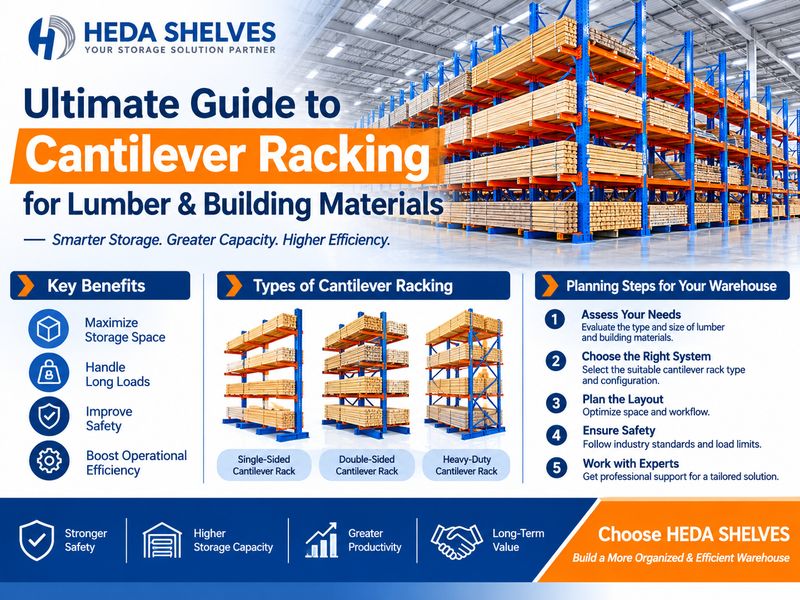
Why Lumber Yards and Building Material Warehouses Need Cantilever Racking
Lumber yards and building material warehouses handle products with different lengths, cross-sections, weights, and packaging methods.
Unlike standard palletized inventory, long materials frequently extend beyond conventional pallet dimensions. Timber boards, structural beams, steel profiles, and pipes require support along their length and sufficient access for forklifts or other handling equipment.
Cantilever racking addresses these requirements through vertical columns and horizontal arms that support materials without front-facing vertical obstructions.
For commercial storage operations, the main benefits include:
Open-Front Storage Access
Cantilever arms extend outward from the upright columns, leaving the front of the storage position open.
This arrangement allows forklifts to approach long materials directly without navigating around front rack columns.
Storage of Different Material Lengths
Lumber and building materials are available in different standard and custom lengths.
Cantilever racking can accommodate these variations through adjustable arm positions, customized arm lengths, and suitable column spacing.
Flexible Storage Levels
Storage levels can be arranged according to the dimensions and weight of the inventory.
This is particularly useful for timber distributors handling multiple lumber sizes and building material suppliers with changing stock requirements.
Multiple Structural Configurations
Different storage requirements call for different structural designs.
Racking-upright systems provide a practical solution for lighter loads, while structural H-steel cantilever systems accommodate heavier storage applications.
The appropriate configuration depends on the actual load, rack height, arm dimensions, and overall warehouse design.
What Materials Can Be Stored on Cantilever Racking?
Cantilever racking is suitable for long, bulky, and irregular materials that require support at multiple positions.
The following material categories are common in lumber and building material warehouses.
2.1 Lumber Boards and Timber Planks
Lumber boards and timber planks are among the most common applications for cantilever racking.
A timber distributor may store different wood species, board thicknesses, and lengths within the same warehouse.
The rack layout should account for:
- Maximum board length
- Bundle width and depth
- Weight per timber bundle
- Number of bundles per storage level
- Required support positions
- Forklift access and loading direction
For long timber products, arm spacing and the number of support points should be selected according to the material's stiffness and allowable deflection.
2.2 Plywood, MDF, and OSB Panels
Panel products require an appropriate support arrangement to avoid excessive bending or damage during storage.
Common products include:
- Plywood sheets
- MDF boards
- OSB panels
- Particleboard
- Laminated wood panels
- Decorative construction panels
The rack depth and support arrangement must accommodate the panel dimensions.
Depending on the panel size and handling method, additional decking or dedicated panel supports may be required.
2.3 LVL and Glulam Structural Beams
Engineered wood products are commonly used in commercial construction and structural building projects.
Examples include:
- Laminated Veneer Lumber (LVL)
- Glued Laminated Timber (Glulam)
- Structural timber beams
- Engineered wood sections
These products may have substantial individual bundle weights and extended lengths.
Heavy-duty structural cantilever racking can be designed with reinforced H-steel columns and customized arms to accommodate these storage requirements.
2.4 Steel Pipes, Tubes, and Profiles
Building material distributors often store metal products alongside timber and wood materials.
Typical products include:
- Steel pipes
- Galvanized tubes
- Structural steel profiles
- Steel bars
- Aluminum extrusions
- Construction tubes
Round materials require additional consideration because they can roll during storage and handling.
Arm stops, suitable end restraints, and an appropriate support arrangement may be required.
2.5 Mixed Building Materials
Large building material warehouses frequently manage multiple inventory categories.
A typical facility may store timber bundles, steel profiles, panel products, and palletized construction supplies.
A combined storage layout can use:
- Cantilever racking for long and irregular materials
- Heavy-duty cantilever racking for heavier structural products
- Selective pallet racking for palletized construction materials
- Industrial shelving for smaller packaged products
The storage system should follow the actual inventory profile and material handling process.
Light-Duty vs. Heavy-Duty Cantilever Racking
The structural design is one of the most important decisions when planning a cantilever racking project.
HEDA SHELVES provides two main structural configurations.
3.1 Light-Duty Cantilever Racking with Racking Uprights
Light-duty cantilever racking uses racking upright structures as its main vertical support.
This configuration is suitable for general long-material storage where the required load capacity and structural dimensions can be accommodated by the racking-upright design.
Typical applications include:
- Lumber boards
- Timber planks
- Medium-weight material bundles
- Long construction products
- General warehouse storage
Available options include adjustable and fixed cantilever arms, single-sided and double-sided configurations, and customized rack dimensions.
The actual load capacity depends on the upright profile, arm dimensions, storage height, and structural configuration.
3.2 Heavy-Duty Structural Cantilever Racking with H-Steel Columns
Heavy-duty cantilever racking uses structural H-steel columns.
This configuration is suitable for industrial applications requiring greater structural strength and project-specific dimensions.
Typical applications include:
- Heavy timber bundles
- LVL and glulam beams
- Large structural wood products
- Heavy steel profiles
- Industrial pipes and tubes
- Oversized construction materials
Structural H-steel columns provide a different load-bearing configuration from racking-upright systems.
The design must consider arm loads, column strength, base dimensions, bracing, anchorage, and the combined loading across all storage levels.
Structural Configuration Comparison
| Specification | Light-Duty | Heavy-Duty |
|---|---|---|
| Main upright | Racking upright | Structural H-steel |
| Main application | General long-material storage | Heavy industrial materials |
| Arm configuration | Adjustable or fixed | Adjustable or fixed |
| Rack arrangement | Single or double-sided | Single or double-sided |
| Maximum height | Up to 12 m | Up to 12 m |
| Arm length | Standard 1,800 mm; custom available | Standard 1,800 mm; custom available |
| Load capacity | Project-specific | Project-specific |
| Surface treatment | Powder coating / hot-dip galvanizing | Powder coating / hot-dip galvanizing |
Both structural types are available with customized dimensions and engineering specifications.
The final selection should be based on the required load, arm length, storage height, and overall rack structure.
Understanding Cantilever Racking Load Capacity: 300–3,000 kg per Layer
Load capacity is one of the most important technical specifications when selecting cantilever racking for lumber and building materials.
HEDA SHELVES provides cantilever racking systems with capacities ranging from 300 to 3,000 kg per storage level.
An important distinction is how this capacity is defined.
HEDA SHELVES capacity definition:
The rated capacity per layer represents the total uniformly distributed load across all cantilever arms on both sides of one storage level.
It is not the capacity of one individual arm or the capacity of each side separately.
For example, a double-sided cantilever rack rated at 2,000 kg per layer has a total allowable uniformly distributed load of 2,000 kg across both sides combined.
The load must be distributed according to the approved structural design.
Factors Affecting Cantilever Racking Capacity
Arm Dimensions
Arm length and structural profile affect the bending forces generated by stored materials.
Longer arms generally require different structural specifications.
Upright Structure
Racking uprights and structural H-steel columns have different structural characteristics.
The appropriate column specification depends on the combined loads transferred from the arms and the required rack height.
Storage Height
Higher structures require careful evaluation of column strength, bracing, stability, and anchorage.
HEDA SHELVES can manufacture cantilever racking up to 12 m high, subject to project-specific engineering.
Number of Storage Levels
The total structural loading increases as additional storage levels are added.
The upright and base structures must be checked for the combined loading condition.
Load Distribution
Uniformly distributed loading and concentrated loading create different structural effects.
The actual material weight and its position on the arms must be included in the design.
For this reason, the rated capacity should always be evaluated together with the approved rack drawings and loading specifications.
Adjustable vs. Fixed Cantilever Arms
Cantilever arms are available in adjustable and fixed configurations.
The choice depends on the material dimensions, inventory changes, and required storage arrangement.
Adjustable Cantilever Arms
Adjustable arms allow storage positions to be changed according to the stored material.
This configuration is suitable for lumber distributors and building material warehouses handling different product dimensions.
Applications include:
- Mixed-length lumber
- Different timber bundle sizes
- Changing inventory dimensions
- Warehouses with multiple product categories
Adjustable arms provide flexibility when storage requirements change.
Fixed Cantilever Arms
Fixed arms are installed at predetermined positions.
They are suitable for warehouses with relatively consistent material dimensions and established storage arrangements.
Potential applications include:
- Standardized timber bundles
- Repetitive industrial materials
- Dedicated long-material storage areas
- Warehouses with stable inventory specifications
Fixed arms can be configured according to the required storage levels and material dimensions.
Arm Length and Customization
The standard cantilever arm length offered by HEDA SHELVES is 1,800 mm.
Customized arm lengths are also available according to the stored material dimensions and project requirements.
The selected arm length must be evaluated together with the rated load, arm profile, upright structure, and load position.
Single-Sided vs. Double-Sided Cantilever Racking
The rack arrangement affects warehouse space utilization, material access, and forklift movement.
Single-Sided Cantilever Racking
Single-sided cantilever racking has storage arms extending from one side of the upright structure.
It is commonly installed:
- Along warehouse walls
- Against building boundaries
- Along the perimeter of outdoor lumber yards
- In storage areas accessible from one direction
The base structure and anchorage must be designed for the loads and overturning forces generated by the cantilever arms.
Double-Sided Cantilever Racking
Double-sided cantilever racking has arms extending from both sides of the central upright structure.
It is suitable for central storage rows where materials can be loaded and retrieved from both directions.
Typical applications include:
- Large lumber warehouses
- Timber distribution centers
- Building material storage yards
- Industrial long-material warehouses
The structural design must consider different loading conditions, including situations where one side carries more material than the other.
Choosing the Right Configuration
| Storage condition | Suitable arrangement |
|---|---|
| Storage along warehouse walls | Single-sided |
| Central warehouse storage rows | Double-sided |
| Perimeter outdoor lumber storage | Single-sided |
| Central rows with access from both sides | Double-sided |
| Mixed material dimensions | Adjustable arms |
| Standardized inventory | Fixed arms |
The final arrangement should be coordinated with the warehouse layout and handling equipment.
Indoor vs. Outdoor Cantilever Racking for Lumber Yards
Lumber and building material storage projects can be installed inside warehouses, under covered structures, or in open outdoor yards.
The installation environment affects the surface treatment, structural design, and foundation requirements.
Indoor Cantilever Racking
Indoor installations generally require consideration of:
- Available building height
- Floor loading capacity
- Forklift operating clearances
- Rack layout and aisle dimensions
- Required storage levels
- Fire protection and building requirements
- Material handling routes
Electrostatic powder coating is a commonly used surface treatment for indoor steel racking.
The rack configuration should be coordinated with the building dimensions and handling equipment.
Outdoor Cantilever Racking
Outdoor lumber yards expose steel structures to rain, humidity, temperature changes, and other environmental conditions.
HEDA SHELVES offers hot-dip galvanizing after fabrication for outdoor cantilever racking applications.
Important considerations include:
Corrosion Protection
Hot-dip galvanizing after fabrication provides a protective zinc coating to the steel components.
The coating specification should be selected according to the installation environment and project requirements.
Wind Loading
Tall outdoor cantilever structures require consideration of site-specific wind conditions.
The design should account for the rack dimensions, stored materials, exposed surfaces, and applicable local requirements.
Foundation and Anchorage
Outdoor installations may require dedicated concrete foundations or footings.
The foundation and anchor specifications must correspond to the structural reactions and actual ground conditions.
Drainage
Water accumulation around base plates and foundations should be addressed during site planning.
Forklift Operation
Outdoor yards may use counterbalance forklifts, side loaders, or telehandlers.
The rack arrangement should provide sufficient clearance for the selected equipment and the longest stored materials.
An indoor rack design should not automatically be applied to an outdoor yard without evaluating these additional conditions.
How to Design a Cantilever Racking Layout for a Lumber Yard
A commercial lumber storage layout should begin with the material inventory and warehouse operating requirements.
Step 1: Classify the Stored Materials
Divide the inventory into material categories according to dimensions, weight, and handling methods.
For example:
- Short and medium-length lumber
- Long timber bundles
- Heavy structural beams
- Plywood and panel products
- Steel pipes and profiles
- Palletized building materials
This classification helps determine which areas need light-duty or heavy-duty cantilever racking.
Step 2: Determine Material Dimensions and Weight
For each category, establish:
- Maximum material length
- Bundle width and depth
- Maximum bundle weight
- Number of bundles per storage level
- Required storage levels
- Required support positions
These details determine the required arm dimensions and structural specifications.
Step 3: Select the Upright Structure
Determine whether the application requires racking-upright construction or structural H-steel.
The choice should be based on the total design load, rack height, arm dimensions, and structural requirements.
Step 4: Determine Arm Length and Column Spacing
Arm length should accommodate the stored material depth.
Column spacing determines the number and location of support positions along the stored material.
Long materials may require multiple support points to control deflection and distribute the load.
Step 5: Determine Rack Height and Storage Levels
Available building height, forklift lifting capability, material dimensions, and storage requirements determine the rack height and number of levels.
HEDA SHELVES can manufacture both racking-upright and structural H-steel cantilever systems up to 12 m high, subject to engineering design.
Step 6: Coordinate Forklift and Aisle Requirements
The handling equipment influences the rack layout and aisle width.
Common options include:
- Counterbalance forklifts
- Side loaders
- Multi-directional forklifts
- Telehandlers
- Overhead cranes for suitable facilities
- Long materials require sufficient turning and placement clearance.
Aisle dimensions should be determined using the handling equipment specifications and actual operating conditions.
Step 7: Complete Structural and Foundation Design
The final engineering design should evaluate:
- Arm capacity
- Column strength
- Base dimensions
- Bracing configuration
- Anchor specifications
- Slab or foundation capacity
- Indoor or outdoor environmental conditions
All these elements form one structural system and should be evaluated together.
Cantilever Racking vs. Pallet Racking for Building Materials
Not every building material should be stored on cantilever racking.
The packaging and physical characteristics of the inventory determine which storage system is appropriate.
| Building material | Recommended storage system | Main consideration |
|---|---|---|
| Long lumber bundles | Cantilever racking | Length and bundle support |
| Timber planks | Cantilever racking | Adjustable storage positions |
| Plywood sheets | Cantilever or dedicated panel storage | Sheet dimensions and support |
| MDF and OSB boards | Cantilever or dedicated panel storage | Panel deflection |
| LVL and glulam beams | Heavy-duty cantilever | Heavy and long materials |
| Steel pipes and profiles | Cantilever racking | Length and rolling risk |
| Palletized cement | Selective pallet racking | Pallet load and access |
| Packaged construction supplies | Selective pallet racking | Pallet dimensions |
| Small construction accessories | Industrial shelving | Picking and SKU organization |
For a warehouse handling both long materials and palletized inventory, a combination of cantilever racking and selective pallet racking can provide a more suitable storage arrangement.
Explore the Selective Pallet Racking System for palletized building materials.
What Determines the Cost of Cantilever Racking for Lumber Storage?
Cantilever racking cost depends on the complete structural configuration and project requirements.
The main cost factors include:
| Cost factor | Impact on project cost |
|---|---|
| Upright structure | Racking upright or structural H-steel |
| Load capacity | Determines arm, column, and base specifications |
| Arm length | Influences structural requirements and material usage |
| Column height | Affects steel consumption and stability |
| Storage levels | Changes combined structural loading |
| Single- or double-sided design | Changes base and structural configuration |
| Surface treatment | Powder coating or hot-dip galvanizing |
| Outdoor installation | May require additional structural and foundation scope |
| Project dimensions | Influences manufacturing and packaging requirements |
When comparing manufacturers, quotations should use consistent assumptions for load capacity, arm length, rack height, structural type, surface treatment, and supply scope.
See the Cantilever Racking Cost Guide for further information.
HEDA SHELVES Cantilever Racking for Lumber & Building Material Projects
HEDA SHELVES manufactures cantilever racking systems for lumber yards, timber distributors, building material warehouses, and industrial long-material storage applications.
The product range includes racking-upright and structural H-steel configurations, with adjustable or fixed arms and single-sided or double-sided arrangements.
Manufacturing Capabilities
| Product specification | HEDA SHELVES capability |
|---|---|
| Load capacity | 300–3,000 kg per storage level |
| Capacity basis | Total uniformly distributed load across all arms on both sides of one level |
| Light-duty structure | Racking upright |
| Heavy-duty structure | Structural H-steel |
| Maximum upright height | Up to 12,000 mm for both structural types |
| Arm configuration | Adjustable or fixed |
| Standard arm length | 1,800 mm |
| Custom arm length | Available |
| Rack arrangement | Single-sided or double-sided |
| Surface treatment | Electrostatic powder coating / hot-dip galvanizing after fabrication |
| Customization | Project-specific dimensions and structural specifications |
Final dimensions and rated capacities are determined according to the approved project design.
Project Design and Manufacturing Support
A lumber yard or building material warehouse requires more than a standard rack configuration.
HEDA SHELVES supports commercial storage projects through:
CAD Warehouse Layout
Warehouse dimensions, material categories, and operating requirements are used to develop a suitable rack arrangement.
3D Rendering
Three-dimensional visualization helps project teams review the proposed storage layout and material flow before manufacturing.
Structural Configuration
Racking upright or H-steel structures, arm dimensions, storage levels, and loading conditions are evaluated for the project.
Manufacturing and Quality Control
Steel components are manufactured according to the approved project specifications, with quality checks throughout production.
Production Inspection
Customers can arrange production inspection to review the manufactured components and project specifications.
Installation Guidance
Technical drawings, assembly instructions, and video installation guidance help customers coordinate installation with their local teams.
Real Project Applications
HEDA SHELVES has manufactured cantilever racking for industrial long-material storage applications.
Actual project photographs can demonstrate:
- Structural H-steel cantilever configurations
- Single-sided and double-sided installations
- Adjustable and fixed arm arrangements
- Outdoor cantilever racking
- Storage of long and bulky industrial materials
These project references help demonstrate the relationship between structural configuration, stored materials, and the actual warehouse environment.
Explore the HEDA SHELVES Cantilever Racking System
For product specifications, structural configurations, and manufacturing options, visit:
HEDA SHELVES Cantilever Racking System
For lumber yard warehouse planning and material storage arrangements, see:
HEDA SHELVES Lumber Yard Storage Solution
Contact HEDA SHELVES to discuss a cantilever racking project based on your material dimensions, storage capacity, warehouse layout, and handling equipment.
Frequently Asked Questions
What is the load capacity of HEDA SHELVES cantilever racking?
HEDA SHELVES offers cantilever racking with capacities ranging from 300 to 3,000 kg per storage level. This capacity represents the total uniformly distributed load across all arms on both sides of one storage level, not the capacity of an individual arm or each side separately. The actual rating depends on the approved structural configuration.
What is the difference between racking-upright and H-steel cantilever racking?
Racking-upright cantilever systems use racking upright structures and are suitable for light-duty applications. Heavy-duty structural cantilever systems use H-steel columns for industrial storage requirements involving heavier materials and larger structural dimensions.
Can HEDA SHELVES manufacture cantilever racking up to 12 meters high?
Yes. Both racking-upright and structural H-steel cantilever systems can be manufactured up to 12 meters high, subject to project-specific structural engineering and loading conditions.
Are cantilever arms adjustable or fixed?
HEDA SHELVES offers both adjustable and fixed cantilever arms. Adjustable arms accommodate changing material dimensions, while fixed arms suit storage layouts with established product specifications.
What is the standard arm length?
The standard arm length is 1,800 mm. Customized arm lengths are available according to the stored material dimensions and project requirements.
Can cantilever racking be used for outdoor lumber storage?
Yes. HEDA SHELVES offers hot-dip galvanizing after fabrication for outdoor cantilever racking applications. The complete installation should also be evaluated for wind loading, foundation requirements, anchorage, and local environmental conditions.
Can cantilever racking store both timber and steel profiles?
Yes. Cantilever racking can accommodate timber, lumber, steel profiles, pipes, tubes, and other long materials when the arm dimensions, support arrangements, and structural specifications are designed for the actual loads.
Should I choose single-sided or double-sided cantilever racking?
Single-sided cantilever racking is generally suitable for perimeter storage and wall-side installations. Double-sided systems are suitable for central storage rows with access from both sides. The choice depends on the warehouse layout, material handling process, and loading conditions.
Can HEDA SHELVES customize cantilever racking for a complete lumber yard project?
Yes. HEDA SHELVES provides project-specific rack configurations, CAD layout drawings, 3D rendering, structural design, and manufacturing. The configuration can be developed around the stored material dimensions, required capacity, available space, and handling equipment.
Does HEDA SHELVES provide installation services?
HEDA SHELVES provides technical drawings, assembly documentation, and video installation guidance to support customer-led installation. Customers can also arrange production inspection before shipment.
Plan Your Lumber Yard Storage System with HEDA SHELVES
From light-duty racking-upright cantilever systems to heavy-duty structural H-steel configurations, HEDA SHELVES manufactures cantilever racking for lumber yards, timber distributors, and building material warehouses.
With capacities from 300 to 3,000 kg per storage level and upright heights up to 12 meters, each project can be developed around the actual material dimensions, storage requirements, and warehouse conditions.