


Warehouse racking systems are fundamental components in modern logistics and storage facilities, meticulously engineered to optimize storage density and streamline operational workflows. By effectively utilizing vertical space, these systems, which primarily include various forms of pallet racking and industrial shelving, allow businesses to store goods efficiently and safely. The choice of system depends heavily on factors like the type of goods stored, required load capacity, inventory turnover rate, and handling equipment used.
Key Takeaways
- Optimization of Vertical Space: Warehouse racking systems maximize storage capacity by utilizing vertical space efficiently.
- Versatility: Suitable for various storage needs, including multiple-SKU, heavy load, long item storage, and FMCG (Fast-Moving Consumer Goods).
- Cost-Effectiveness: Increases inventory holding capacity without expanding the warehouse footprint.
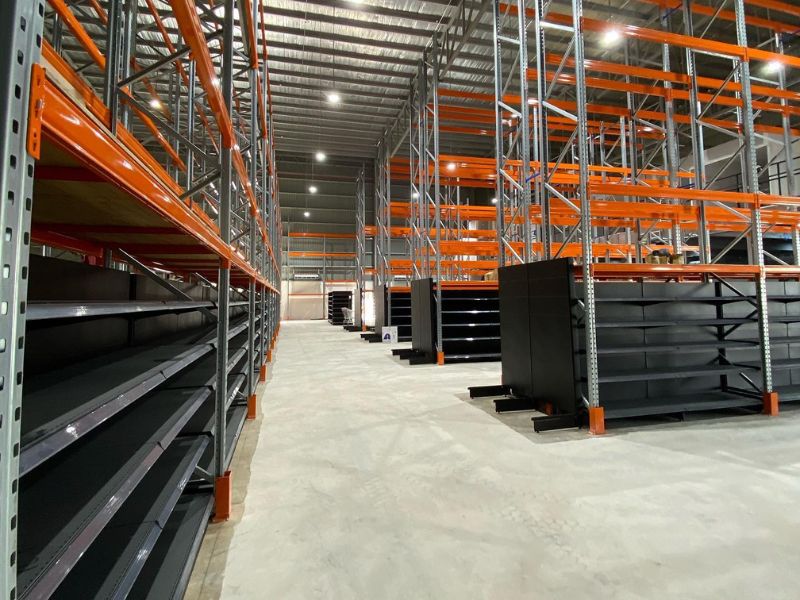
What is a warehouse racking system?
Warehouse racking is storage systems used in most warehouses to hold inventory. Usually, warehouse rack, including pallet racking & storage shelving, are divided by their load capacity and applications.
At its core, a warehouse racking system is an engineered structure designed for storing materials on pallets or in containers in multiple levels of horizontal rows stacked vertically. Typically constructed from high-strength steel components like upright frames, horizontal beams, and bracing elements, these systems form stable, multi-level shelves accessible by forklifts or other material-handling equipment.
The primary goal is vertical space optimization, turning cubic meters into accessible storage positions. Modern racking systems are highly adaptable and are designed to accommodate various storage needs, including:
- High-density storage for bulk goods
- Selective storage for facilities with many different Stock Keeping Units (SKUs)
- Solutions for heavy or awkwardly shaped loads (e.g., lumber, pipes)
- Systems optimized for Fast-Moving Consumer Goods (FMCG) requiring specific inventory rotation (like FIFO - First-In, First-Out).
Warehouse racking systems consist of several warehouse racks, which are industrial shelving units made of metal designed to store boxes or pallets in multiple levels of horizontal rows stacked on top of each other. Therefore, warehouse racking focuses on optimizing your vertical space storage. To adapt to many storage needs such as multiple-SKU, heavy load, long item storage, and FMCG (Fast-Moving Consumer Goods), etc.
What are racking systems used for in warehouses?
Many warehouse manager choose a racking system to optimize their storage space. Why? What does the warehousing business sell? It is time and space which is the essential factors to starting a warehouse.
Racking systems can double or triple your warehouse's inventory holding capacity without increasing the square footage you pay for, making them a cost-effective solution for small businesses looking to maximize their warehousing storage space.
Benefit of Racking system achieves this by:
- Dramatically Increasing Storage Capacity: Racking can easily double or triple the amount of inventory stored within the same building footprint by utilizing vertical height. This avoids or postpones the need for costly expansions or moves.
- Improving Inventory Management: Assigning specific rack locations (often barcoded) to SKUs drastically improves organization, traceability, and picking accuracy compared to floor stacking. This is crucial for efficient inventory control and reducing errors.
- Enhancing Operational Efficiency: Organized storage allows for faster put-away and retrieval times, streamlining workflows and reducing labor costs associated with searching for items.
- Boosting Safety: Properly designed and installed racking provides stable storage, reducing the risk of product damage and personnel injury associated with unstable, haphazard stacks. It also helps maintain clear aisles.
- Cost Savings: By maximizing the utility of existing space, racking lowers the overall cost per pallet position stored, making warehousing operations more economical.
How much do warehouse racks cost?
The cost of a racking system depends on the type of racking system you purchase. In general, the simpler the racking system, the less expensive it will be.
Here is a list of various racking system designs, as well as descriptions and cost estimates (including installation) for each:
| Type of Racking | Features | Application | Cost Range (per pallet position unless noted) | Build Time |
|---|---|---|---|---|
| Selective Pallet | Direct access, adjustable beams, steel | Diverse SKUs, retail, distribution | $50 - $100 | 1-3 days (small); 1-2 weeks (large) |
| Drive-In | LIFO, high density, forklift entry | Bulk, low-turnover, cold storage | $100 - $150 | 3-7 days (small); 2-4 weeks (large) |
| Drive-Through | FIFO, dual entry, gravity-assisted | Perishables, high rotation | $110 - $160 | 4-8 days (small); 2-5 weeks (large) |
| Double-Deep | Two-deep storage, partial selectivity | Medium-turnover, fewer SKUs | $80 - $200 | 2-5 days (small); 1-3 weeks (large) |
| Pallet Flow | FIFO, gravity rollers, high density | Fast-moving, perishables, fulfillment | $200 - $500 | 5-10 days (small); 3-6 weeks (large) |
| Push-Back | LIFO, nested carts, 2-6 pallets deep | Medium-turnover, multiple SKUs | $200 - $400 | 4-8 days (small); 2-4 weeks (large) |
| Cantilever | Open-front, adjustable arms, no columns | Long/irregular items (lumber, pipes) | $150 - $300 (per linear foot) | 2-5 days (small); 1-3 weeks (large) |
| Mobile Racking | Motorized bases, full selectivity | Small spaces, cold storage, high-value | $300 - $600 | 1-2 weeks (small); 4-8 weeks (large) |
Safety Standards for Warehouse Racking
Ignoring racking safety can lead to catastrophic collapses, serious injuries, costly downtime, and regulatory fines. Maintaining a safe racking system involves several key practices:
Regular Inspections: Implement a program for regular inspections (at least annually, often bi-annually recommended) by trained personnel or certified third-party inspectors. Look for damage (dents, twists, corrosion), overloaded beams (deflection), missing/damaged components (bracing, connectors, anchors), and plumbness issues. Follow standards like RMI MH16.1 (US) or EN 15635 (Europe).
Proper Installation & Anchoring: Racks must be installed according to manufacturer specifications and securely anchored to the concrete floor using appropriate anchors to prevent tipping or movement, especially in seismic zones.
Adherence to Load Capacities: Never exceed the manufacturer's rated load capacity. Load capacity plaques showing maximum load per beam level and per bay must be clearly visible on the racking. Ensure all warehouse staff understand these limits.
Use of Safety Equipment: Install essential safety components like beam locking pins (safety clips), column protectors (post guards) to mitigate forklift impact damage, and appropriate decking (wire mesh or solid) to support pallets and prevent items from falling.
Operator Training: Ensure forklift operators are properly trained in safe operating procedures around racking, including careful load placement, speed control, and avoiding impacts.
How is Warehouse Racking System load calculated?
Calculating the load capacity of a racking system is a critical engineering task performed by qualified professionals to ensure structural integrity and safety. It's not just about the materials; it's about how they interact under load. Here's an overview of the process:
Key Inputs: The calculation starts with defining the maximum expected weight and dimensions of the pallet load, the number of pallets per beam level, the number of levels, beam lengths, upright frame heights, and the specific location (for seismic design requirements).
Beam Capacity Calculation: Engineers calculate the total load per beam pair (Max Pallet Weight x # Pallets per Level). They then select a beam profile whose rated capacity (determined through testing and analysis considering its length, shape, and material strength) exceeds this required load, while also meeting deflection limits (how much it can safely bend).
Upright Frame Capacity Calculation: This is more complex. The total load from all beam levels in a bay is calculated (Load per Beam Level x # Levels). Engineers analyze the chosen upright frame's ability to handle this cumulative vertical load without buckling. This capacity depends heavily on the frame's height, steel profile, bracing pattern, and the vertical distance between beam levels (the "unbraced length").
System Stability & Anchoring: The design must also account for overall stability against horizontal forces (impacts, seismic loads) using appropriate bracing (plan and elevation) and secure floor anchoring calculated to resist uplift and shear forces.
Standards & Expertise: All calculations adhere to industry standards (like RMI ANSI MH16.1 or EN 15512) and incorporate safety factors. This work must be done by the manufacturer's engineers or qualified structural engineers.
Conclusion
Warehouse racking systems are far more than just simple shelving; they are engineered solutions vital to the efficiency, safety, and profitability of modern warehouse operations. By providing organized, dense, and accessible storage, they form the backbone of effective inventory management.
Choosing the right system requires careful consideration of your specific products, throughput, space, and budget.
Whether setting up a new facility or optimizing an existing one, partnering with experienced suppliers and installers is crucial. Experts like Heda Shelves, a leading racking system manufacturer and supplier in China since 2001, can help design and implement a solution tailored to your unique needs, ensuring you maximize your storage potential safely and cost-effectively.
Warehouse rack FAQs
1. How much does it cost to rack a warehouse?
The cost of racking a warehouse varies significantly based on the type of racking system, its size, and installation complexity. Here are some general estimates:
- Selective Pallet Racking: Costs range from $50 to $100 per pallet position, with installation costs typically between 15% and 25% of the equipment cost.
- Drive-In Racking: Equipment costs between $100 and $150 per pallet position, with installation costs ranging from 20% to 35%.
- Push-Back and Pallet Flow Racking: Both typically cost between $200 and $400 per pallet position, with similar installation costs.
- For a 25,000-square-foot warehouse, the total cost can range from $375,000 to $2.5 million for the equipment alone, depending on the system chosen.
2. How much weight can a pallet rack hold?
The weight capacity of a pallet rack depends on several factors, including the type of racking system, beam size, upright frame strength, and material quality. Generally, beam capacities can vary from 1,000 to 3,000 pounds per pair of beams, depending on the manufacturer and design. It's crucial to consult the manufacturer's specifications and ensure that the rack is properly installed and maintained to avoid overloading.
3. How much space do you need between pallet racks?
The space needed between pallet racks is primarily determined by safety and operational considerations. It's recommended to maintain at least 6 inches of clearance between racks to prevent damage from impacts, though this can increase to 12-18 inches depending on the size of the rack and product5. Additionally, racks should be at least 3 inches away from walls to prevent structural damage.
4. How wide do aisles need to be in a warehouse?
Aisle widths in warehouses depend on the type of forklifts used and the size of the pallets. Here are some general guidelines:
Wide Aisles: Typically 12-13 feet wide, suitable for standard sit-down counterbalanced forklifts.
Narrow Aisles: Range from 8 to 10 feet wide, ideal for stand-up trucks and reach trucks.
Very Narrow Aisles (VNA): Less than 6 feet wide, used with specialized VNA forklifts.
Aisle width should also account for pallet overhang and maneuverability space